
Blog
How to Balance Chemical Equations Without Guessing
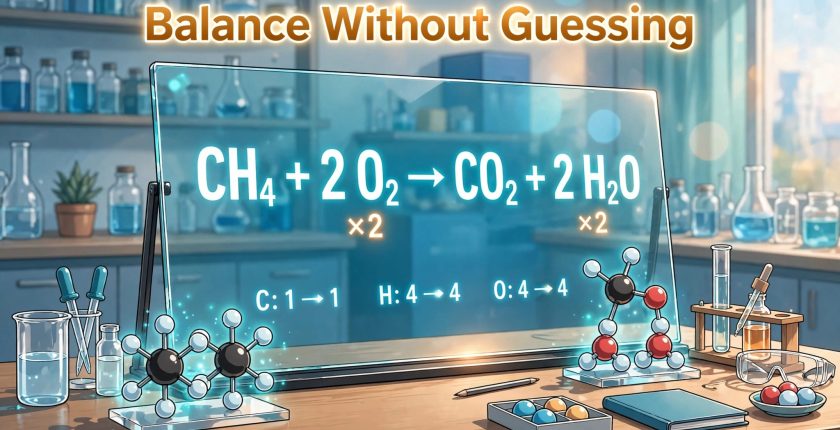
Changing numbers at random can turn a short chemistry problem into a frustrating loop. Balancing chemical equations is more reliable when you count atoms and use clear numerical relationships.
You don’t need to guess: a chemical equation is balanced by adjusting coefficients while keeping each formula intact. Never change its subscripts to make the number of atoms match.
Key Takeaways
- Balance chemical equations by changing coefficients, never subscripts, so each chemical formula stays intact.
- Count each element on both sides and update the counts whenever you change a coefficient.
- Use the least common multiple to match uneven atom counts, and multiply every coefficient by the same number to clear fractions.
- Treat a polyatomic ion as a unit only when it stays intact on both sides of the equation.
- Check every element, check net charge in ionic equations, and reduce coefficients to the smallest whole-number ratio.
The rule behind balancing chemical equations
The law of conservation of mass requires the same number of each element’s atoms on both sides of a chemical reaction.
As OpenStax’s guide to chemical equations explains, balancing changes coefficients while preserving chemical formulas and their subscripts.
Coefficients multiply the entire formula. For example, 3 H₂O represents three water molecules, with six hydrogen atoms and three oxygen atoms.
A subscript belongs to the substance itself. Changing subscripts to turn H₂O into H₂O₂ replaces water with hydrogen peroxide. That’s a different reaction, not a balanced version of the original.
A missing coefficient or subscript means 1. Before changing anything, count the atoms in each formula.
Seven steps for balancing chemical equations systematically
Balancing chemical equations by inspection starts with counting atoms and changing coefficients, never subscripts. This makes the process systematic rather than trial and error.
- Write the correct formulas. Identify every reactant and product before you begin.
- Count atoms of each element on both sides, including those in parentheses. Multiply each count by its coefficient.
- Start with the most complex formula. Choose an element that appears in only one formula on each side when possible.
- Match its atom count with coefficients. Use the least common multiple when the counts differ.
- Repeat for the remaining elements. Treat an unchanged polyatomic ion as a unit, and usually leave hydrogen and oxygen until later.
- Save simple substances and pure elements, such as O₂, for last. Clear fractions by multiplying every coefficient by the denominator.
- Recount each atom and reduce the numbers to the smallest whole-number ratio.
After each change, update all affected counts. Adding a coefficient to H₂O changes both hydrogen and oxygen, so an earlier tally may need updating.
Worked examples: propane and butane combustion
For complete hydrocarbon combustion, balance carbon first, hydrogen second, and oxygen last.
Propane: carbon, then hydrogen, then oxygen
Start with:
C₃H₈ + O₂ -> CO₂ + H₂O
Propane contains three carbon atoms, so put 3 before CO₂ to match the carbon atoms:
C₃H₈ + O₂ -> 3 CO₂ + H₂O
Next, match eight hydrogen atoms with four H₂O molecules:
C₃H₈ + O₂ -> 3 CO₂ + 4 H₂O
Now count oxygen on the right. Three CO₂ molecules contribute six oxygen atoms, while four H₂O molecules contribute four.
That gives ten oxygen atoms, requiring five O₂ molecules:
C₃H₈ + 5 O₂ -> 3 CO₂ + 4 H₂O
The coefficients are 1, 5, 3, 4. We normally omit the written 1.
Butane: clear the fractional coefficient
Start with:
C₄H₁₀ + O₂ -> CO₂ + H₂O
Four carbon atoms require 4 CO₂. Ten hydrogen atoms require 5 H₂O:
C₄H₁₀ + O₂ -> 4 CO₂ + 5 H₂O
The products contain eight plus five oxygen atoms, giving thirteen altogether. Therefore, the oxygen coefficient is 13/2:
C₄H₁₀ + 13/2 O₂ -> 4 CO₂ + 5 H₂O
A fractional coefficient is allowed during the calculation. Multiply every coefficient by 2 to get whole numbers:
2 C₄H₁₀ + 13 O₂ -> 8 CO₂ + 10 H₂O
The final coefficients use whole numbers, with no common factor remaining.
Fix uneven counts with multiples and intact groups
Use the least common multiple
Consider aluminum oxide formation:
Al + O₂ -> Al₂O₃
Oxygen appears in groups of two and three. Their least common multiple is six, so use 3 O₂ and 2 Al₂O₃.
Those two aluminum oxide units contain four aluminum atoms. This gives:
4 Al + 3 O₂ -> 2 Al₂O₃
The same reasoning works for iodine and fluorine forming IF₇. Fluorine appears in groups of two and seven, whose least common multiple is fourteen:
I₂ + 7 F₂ -> 2 IF₇
Both sides contain two iodine atoms and fourteen fluorine atoms.
Resolve odd-even mismatches
For aluminum reacting with hydrochloric acid, start with:
Al + HCl -> AlCl₃ + H₂
Matching chlorine gives 3 HCl for each AlCl₃. However, three hydrogen atoms require 3/2 H₂, a fractional coefficient:
Al + 3 HCl -> AlCl₃ + 3/2 H₂
Scale all coefficients together by two to clear the fraction:
2 Al + 6 HCl -> 2 AlCl₃ + 3 H₂
This gives six hydrogen on each side. The coefficients must stay in the same proportion; arbitrary doubling before establishing their relationship isn’t a method.
Balance unchanged polyatomic ions together
If phosphate stays intact on both sides, count PO₄ as one unit:
CaCl₂ + Na₃PO₄ -> Ca₃(PO₄)₂ + NaCl
One Ca₃(PO₄)₂ needs two phosphate groups, so choose 2 Na₃PO₄. Three calcium atoms then require 3 CaCl₂.
Finally, six sodium and six chlorine require 6 NaCl:
3 CaCl₂ + 2 Na₃PO₄ -> Ca₃(PO₄)₂ + 6 NaCl
Use this shortcut only when the group remains unchanged. If nitrate breaks apart during decomposition, count nitrogen and oxygen separately.
Use algebra when inspection gets tangled
Choose a method based on the equation’s structure.
| Method | Useful starting point |
|---|---|
| Systematic inspection | Simple equations with easy atom matches |
| Algebraic method | Several linked coefficients |
| Oxidation-number method | Redox equations with clear oxidation-state changes |
| Half-reaction method | Ionic redox equations requiring charge balance |
Inspection is usually quickest for introductory problems. Algebra turns coefficient choices into equations you can solve directly.
Assign a variable to each coefficient
Take iron(III) oxide formation:
a Fe + b O₂ -> c Fe₂O₃
Write one equation for each element, matching its atoms on both sides:
For iron, a = 2c.
For oxygen, 2b = 3c.
These equations express conservation of atoms. Each side must contain the same number of atoms for every element.
Because coefficients describe a ratio, set one temporarily to establish a scale. Let c = 1.
Solve and convert to whole numbers
With c = 1, the iron equation gives a = 2. The oxygen equation gives b = 3/2.
Substitute those values:
2 Fe + 3/2 O₂ -> Fe₂O₃
Then multiply the entire equation by 2:
4 Fe + 3 O₂ -> 2 Fe₂O₃
For larger equations, use substitution or elimination to solve the simultaneous equations. If several fractions remain, multiply all values by the least common multiple of their denominators.
Redox equations must balance charge as well
For ionic redox reactions, atom counts alone aren’t enough. You must also conserve charge and account for electron transfer, as covered in OpenStax’s reaction classification guide.
In acidic solution, permanganate oxidizes Fe²⁺ to Fe³⁺.
For each half-reaction, balance elements other than hydrogen and oxygen first. Balance oxygen with H₂O, hydrogen with H⁺, and charge with electrons.
The balanced reduction half-reaction is:
MnO₄⁻ + 8 H⁺ + 5 e⁻ -> Mn²⁺ + 4 H₂O
The oxidation half-reaction is:
Fe²⁺ -> Fe³⁺ + e⁻
Multiply the iron equation by five so both equations transfer five electrons. Combine them and cancel the electrons:
MnO₄⁻ + 5 Fe²⁺ + 8 H⁺ -> Mn²⁺ + 5 Fe³⁺ + 4 H₂O
The tally is one manganese atom, five iron atoms, four oxygen atoms, and eight hydrogen atoms.
The left charge is -1 + 10 + 8 = +17. The right charge is +2 + 15 = +17.
Check the final equation with an atom tally
For propane combustion, use the final equation to count atoms rather than relying on earlier working.
| Element | Reactant atoms | Product atoms |
|---|---|---|
| Carbon | 1 × 3 = 3 | 3 × 1 = 3 |
| Hydrogen | 1 × 8 = 8 | 4 × 2 = 8 |
| Oxygen | 5 × 2 = 10 | (3 × 2) + (4 × 1) = 10 |
Every row matches, so the result is a balanced equation.
Next, check whether all coefficients share a common factor. If they do, divide each by it. For example, 4 H₂ + 2 O₂ -> 4 H₂O reduces to 2 H₂ + O₂ -> 2 H₂O.
Matching total atoms isn’t enough. Each element must match separately, and ionic equations must also have equal net charge.
Practice problems with balanced answers
Cover the answer column, follow the seven-step method, then compare your coefficients. Each answer uses the smallest whole-number ratio.
| Unbalanced equation | Balanced answer |
|---|---|
| Na + Cl₂ -> NaCl | 2 Na + Cl₂ -> 2 NaCl |
| KClO₃ -> KCl + O₂ | 2 KClO₃ -> 2 KCl + 3 O₂ |
| SO₂ + O₂ -> SO₃ | 2 SO₂ + O₂ -> 2 SO₃ |
| NH₃ + O₂ -> NO + H₂O | 4 NH₃ + 5 O₂ -> 4 NO + 6 H₂O |
| Pb(NO₃)₂ + NaCl -> PbCl₂ + NaNO₃ | Pb(NO₃)₂ + 2 NaCl -> PbCl₂ + 2 NaNO₃ |
If an answer differs, recount the atoms before changing coefficients. In the final problem, nitrate stays intact, so balancing it as a group saves work.
For further practice, OpenStax’s chemical reaction exercises include equation-writing and balancing problems.
For a broader foundation, the introductory reactions and ratios course covers chemical reactions, stoichiometry, and chemical problem-solving.
Use online balancers to check your reasoning
An online balancer generally asks you to enter the reactants and products, then click Balance. Follow its input syntax for formulas, charges, and reaction separators.
Complete your own tally of atoms before checking the output. Comparing the answers can help you find a missed subscript, an uncleared fraction, or a coefficient applied to only part of a formula.
Some tools also accept reagents alone and suggest a complete reaction. Product prediction is a separate task, since conditions can change which products form. A mathematically balanced suggestion doesn’t prove that the reaction occurs.
If you need someone to work through difficult equations at your pace, Find your tutor here. Bring your working so the lesson can focus on the step that’s causing trouble.
Frequently Asked Questions
What can I change when balancing a chemical equation?
Change the coefficients in front of formulas, not the formulas’ subscripts. A subscript change creates a different substance.
Which element should I balance first?
Start with the most complex formula and, when possible, choose an element that appears in only one formula on each side. For hydrocarbon combustion, balance carbon first, hydrogen second, and oxygen last.
Are fractional coefficients allowed?
Yes, fractions can help match atom counts during the calculation. Multiply every coefficient by the fraction’s denominator to get whole numbers, then reduce them if they share a common factor.
How do I balance an ionic redox equation?
Balance atoms in each half-reaction, then balance charge with electrons. Make the electron counts equal, combine the half-reactions, cancel electrons, and check that the net charges match.
Finish with evidence, not a guess
Reliable balancing applies conservation of mass: keep each chemical equation’s formulas unchanged, adjust coefficients, and verify the result with a fresh tally of atoms.
When every element matches, charge matches where needed, and the numbers have no common factor, the answer rests on evidence, not guesswork.
If you choose to purchase a product or service through one of these links, we may receive a commission at no additional cost to you. Any recommendations are provided for informational purposes only.