
Blog
Why Seasons Change on a Nearly Circular Orbit
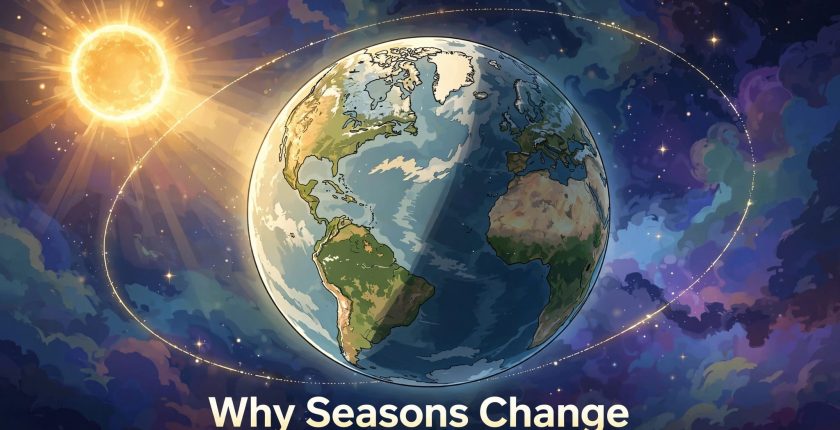
Seasons change because Earth’s tilted axis changes sunlight angle and daylight hours as Earth orbits the Sun. The main cause is axial tilt, rather than Earth’s changing distance from the Sun.
That distinction explains why seasons change even on a nearly circular orbit, and why the hemispheres experience opposite seasons. Start with the direction Earth’s axis points.
Why seasons change: sunlight angle and day length
Earth’s axial tilt is about 23.5 degrees from a line perpendicular to its orbital plane. Throughout each yearly orbit, that axis keeps pointing almost the same way in space.
Earth’s rotation takes about 24 hours, while its orbit around the Sun takes 365.25 days. Rotation produces day and night. Meanwhile, Earth’s orbit changes which hemisphere leans toward the Sun.

Higher sunlight angles concentrate energy
When your hemisphere leans toward the Sun, sunlight strikes the ground more directly. The same amount of solar energy from the Sun covers a smaller area, so each square metre receives more energy.
For example, ignoring atmospheric effects, a beam arriving 30 degrees above the ground spreads across twice the area of a vertical beam. Shallower winter sunlight therefore heats the surface less effectively.
Longer days add more heating time
Summer also brings longer daylight hours, giving the ground more time to absorb sunlight. In winter, shorter days reduce heating, while longer nights allow more cooling.
Both effects work together: summer sunlight is more concentrated and lasts longer. Because the hemispheres lean in opposite directions relative to the Sun, summer in Australia coincides with winter in Europe.
Earth’s distance changes, but doesn’t drive the seasons
Earth’s orbit is slightly elliptical. At perihelion, its closest point to the Sun, in early January, Earth is about 91.4 million miles away. At aphelion, its farthest point, in early July, it’s about 94.5 million miles away.
The perihelion-to-aphelion difference is roughly 3 million miles. Earth is closest during Northern Hemisphere winter and farthest during its summer, while the Southern Hemisphere has opposite seasons. NASA’s explanation of the seasons highlights this mismatch between distance and Northern Hemisphere temperatures.
Distance from the Sun does slightly affect the solar energy reaching Earth. However, it can’t explain opposite seasons happening simultaneously; Earth’s axial tilt does.
Both hemispheres share essentially the same distance from the Sun, yet one can experience summer while the other experiences winter.
Even with a perfectly circular orbit, Earth’s present tilt would still produce seasons. Without tilt, the familiar yearly changes in sunlight angle and daylight would largely disappear.
Solstices and equinoxes mark the seasonal cycle
A solstice occurs when the Sun reaches its northernmost or southernmost position in Earth’s sky. An equinox occurs when the Sun crosses the equator.
These approximate dates mark the astronomical seasons:
| Event | Usual date | Northern Hemisphere | Southern Hemisphere |
|---|---|---|---|
| March equinox | March 20 or 21 | Spring | Autumn |
| June solstice | June 20 or 21 | Summer | Winter |
| September equinox | September 22 or 23 | Autumn | Spring |
| December solstice | December 21 or 22 | Winter | Summer |
Exact dates vary with the year and time zone. June brings the Northern Hemisphere’s longest daylight period; December brings its shortest.
At the equinoxes, day and night are nearly equal in length, rather than exactly equal everywhere. The National Weather Service’s seasonal guide explains these milestones.
Seasons look different around the world
Tropical rainfall and polar daylight
Near the equator, daylight stays close to 12 hours throughout the year, and seasonal temperature changes are relatively small. Many tropical regions instead experience wet and dry seasons.
These rainfall patterns often follow the shifting Intertropical Convergence Zone, a belt where winds meet and moist air rises. However, local geography and monsoons also shape tropical weather.
At the poles, the same axial tilt produces months of continuous summer daylight and months of winter darkness. Between the tropics and poles, changing sunlight produces the familiar spring, summer, autumn, and winter pattern.
Heat storage and autumn color
The hottest weather usually arrives after the longest day because oceans and ground take time to warm. Temperatures keep rising while incoming energy exceeds energy lost.
As a result, many northern locations are warmest in late July or August. Daily temperatures also commonly peak after solar noon, often around 2 to 4 p.m., depending on conditions.
In autumn, shorter days and cooling temperatures trigger changes in many deciduous trees. Chlorophyll breaks down, revealing yellow and orange carotenoids already present. Some leaves also produce red anthocyanins, so autumn red isn’t simply an uncovered pigment.
How Earth acquired its tilt
Earth’s early collisions helped establish its spin and tilt. Under the giant impact hypothesis, a roughly Mars-sized body struck the young Earth, and debris from the collision formed the Moon.
That impact likely influenced Earth’s rotation, although scientists haven’t reduced today’s tilt to one precisely reconstructed collision.
Over much longer timescales, changes in Earth’s tilt and orbital geometry alter seasonal sunlight patterns. These Milankovitch cycles help pace ice ages; they don’t explain the ordinary yearly seasonal cycle.
For further astronomy study, our beginner-level Science of the Solar System course provides a starting point.
For one-to-one support with astronomy or physics concepts, Find your tutor here.
If you choose to purchase a product or service through one of these links, we may receive a commission at no additional cost to you. Any recommendations are provided for informational purposes only.