
Blog
How to Answer Science Experiment Method Questions
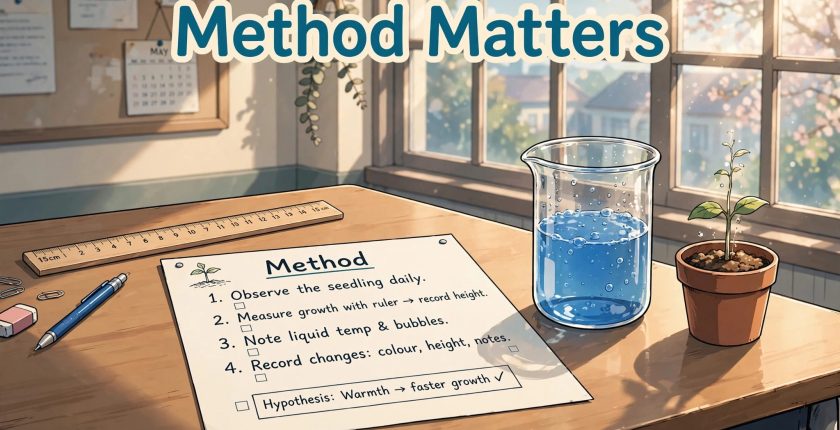
To answer science experiment method questions, identify what changes, what gets measured, and what must stay constant. Then explain how the method produces trustworthy evidence, using details from the question.
You don’t need to memorise a separate answer for every experiment. The same reasoning applies to melting ice, testing paper towels, and investigating plant growth.
Start with the scientific method, then practise applying it to unfamiliar questions.
Key Takeaways
- Identify variables by their roles in the experiment, rather than guessing from their names.
- Explain exactly how an improvement addresses a weakness.
- Support conclusions with measurements, including units.
- Attempt practice questions before reading their answers, then revisit mistakes after a gap.
Learn the Scientific Method Steps in Order
A common classroom sequence has six steps:
- Ask a question. Identify something measurable to investigate.
- Make a hypothesis. Propose a testable explanation or prediction.
- Test the hypothesis. Plan and carry out an appropriate investigation.
- Analyze results. Organise measurements, calculate summaries, and identify patterns.
- Draw conclusions. Decide whether the evidence supports the hypothesis.
- Communicate results. Report the method, findings, and limitations.
Observations and background research can inform several steps. If a quiz asks for this sequence, give it in order.
However, real research doesn’t always follow a fixed list. The NSTA’s Nature of Science statement explains that no universal step-by-step method captures all scientific work.
William McComas challenged this rigid picture in his 1996 essay, “Ten Myths of Science.” Nature of Science teaching addresses such misconceptions, but curricula haven’t followed one universal replacement timetable.
Scientists may revisit their questions, revise explanations, or use observations rather than controlled experiments. In classroom scientific method experiments, this six-step sequence helps organise answers.
Write Testable Questions and Hypotheses
Choose a question with measurable variables
First, ask a question that links a factor you can change to an outcome you can measure:
“Does the amount of salt in water affect the temperature at which it boils?”
This identifies salt amount and boiling temperature. However, it requires suitable equipment and adult supervision.
Turn your idea into a testable prediction
School questions often describe a hypothesis as a testable prediction. More precisely, a hypothesis proposes an explanation, and a prediction describes the expected observation.
An if-then statement makes the prediction clear:
“If identical ice cubes are placed on metal and wood at the same starting temperature, then the cube on metal will melt faster.”
Add the explanation: metal generally transfers heat to the ice more effectively than wood under these conditions.
This is more useful than “Will ice melt faster on metal?” because it predicts a measurable outcome rather than repeating the question.
Identify Variables and Control Groups
Separate what changes from what gets measured
In a simple fair test, the independent variable is the factor deliberately changed. The dependent variable is the response measured.
Controlled variables are relevant conditions kept the same, not literally everything in the room. State how you’ll maintain them.

Distinguish a control group from controlled variables
In a controlled experiment, a control group provides a comparison baseline, but not every investigation needs one. An experimental group receives the treatment being investigated.
For example, a fertiliser investigation could compare fertilised plants with otherwise similar plants receiving no fertiliser. Both groups still need comparable water and light.
As Khan Academy’s controlled-experiment guide explains, this comparison helps isolate the treatment’s effect.
In school fair tests, change one factor at a time, though advanced experiments can deliberately examine several factors.
Explain Fair-Test Improvements Precisely
An improvement answer needs two parts: what to change and why it helps.
“Use equal-mass ice cubes so differences in melting time aren’t caused by different amounts of ice” identifies a confounding factor and addresses it.
Similarly, “Repeat each condition with fresh samples and calculate the mean” helps assess variation between trials. Repeating a test doesn’t automatically remove systematic error, such as a consistently misreading thermometer.
Taking more readings with a faulty instrument can produce a consistent answer that remains inaccurate.
For evaluation questions, connect each criticism to its likely effect. “The method is unreliable” earns less credit than identifying inconsistent measurements and explaining an appropriate repair.
The guide to exam command words distinguishes describing a method from explaining or evaluating it.
Analyze Data and Write Supported Conclusions
Choose suitable units and graphs
Match the unit to the quantity and scale. Milligrams are suitable for a fly’s mass, millilitres for soda volume, and kilometres for distance between cities. Very small masses may be more conveniently expressed in milligrams.
The NIST guide to SI units distinguishes quantities such as mass, length, and temperature.
Use a bar graph to compare categories, such as the prices of six different cars. For numerical variables, such as salt concentration and boiling temperature, a scatter graph may be more appropriate.
Include a meaningful title, labelled axes, units, and a sensible scale.

Connect the evidence to the hypothesis
Start with: “My hypothesis was supported because…” or “My hypothesis was not supported because…”
Then give evidence rather than repeating your prediction.
For example, these approximate physical values describe pure water’s boiling point at two pressures:
| Pressure | Approximate boiling temperature |
|---|---|
| 101.3 kPa | 100°C |
| 50 kPa | 81°C |
These values support the prediction that reducing pressure lowers water’s boiling temperature.
A complete conclusion could read: “The hypothesis was supported because water’s boiling temperature was lower at 50 kPa than at 101.3 kPa.”
Avoid saying one comparison proves a hypothesis universally.
Apply the Method to Classroom Experiments
These classroom scientific method experiments are starting points, not fixed designs. Adapt each one to the question, available equipment, and project needs, including for a science fair.
Practise Questions, Then Use the Answer Key
Answer these without notes. For further practice, use the approach to marking practice test papers to record error causes and choose fresh questions.
If you need individual support with experimental reasoning, Find your tutor here and focus lessons on recurring mistakes.
Build Answers Around Evidence
Strong method answers connect the experimental detail to its purpose. Name the variable, describe the measurement, or propose an improvement, then explain why it matters.
Practise applying that reasoning to new investigations rather than memorising complete responses. A clear link between the method and the evidence will help you answer unfamiliar science questions with confidence.
If you choose to purchase a product or service through one of these links, we may receive a commission at no additional cost to you. Any recommendations are provided for informational purposes only.