
Blog
How to Solve Quadratic Equations by Factorising
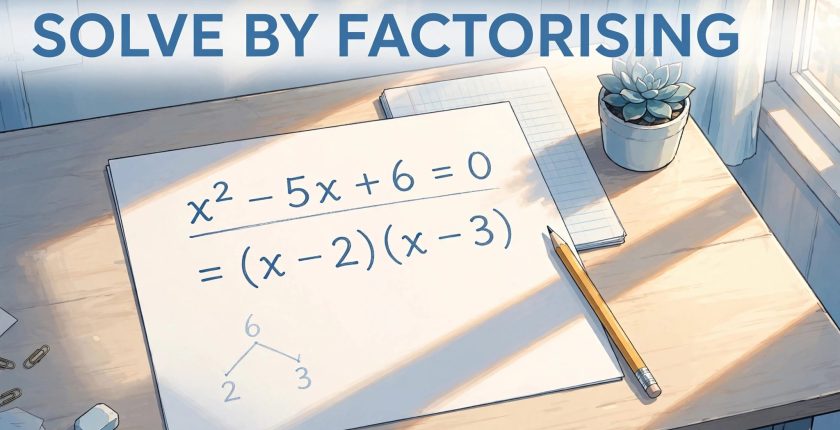
When asked to solve the quadratic equation by factorising, rearrange it to equal zero, write it as a product, then set each factor equal to zero. The zero-product property tells you why this works: if two numbers multiply to zero, at least one must be zero.
Factorising is often the quickest method for solving quadratic equations with simple factors. Start by putting the equation into a form where you can spot those factors.
Key Takeaways
- Rearrange the equation into ax² + bx + c = 0 before factorising.
- When a = 1, find two numbers that multiply to c and add to b.
- Set each factor equal to zero, solve both equations, then check each answer in the original equation.
Put the Quadratic Equation in Standard Form
The standard form for a quadratic is:
ax² + bx + c = 0, where a ≠ 0.
The letters a, b and c are coefficients, with c also called the constant term. When typing without superscripts, the same standard form is written as ax2 + bx + c = 0. If a were zero, the squared term would disappear, so the equation wouldn’t be quadratic.
Before factorising or using the quadratic formula, collect every term on one side. Apply the same operation to both sides to keep the equation balanced.
For example:
x² – 4x = -1
Add 1 to both sides:
x² – 4x + 1 = 0
Here, a = 1, b = -4 and c = 1. Include each sign when identifying coefficients. In particular, b is -4, not 4.
Find the Factors When a = 1
For x² + bx + c, use the factoring (factorising) pattern: look for two numbers, p and q, such that:
p × q = c and p + q = b.
Then x² + bx + c = (x + p)(x + q).
Choose the Number Pair
Consider x² + 7x + 12.
The positive factor pairs of 12 are 1 and 12, 2 and 6, and 3 and 4. Only 3 and 4 add to 7.
Therefore:
x² + 7x + 12 = (x + 3)(x + 4)
You can check by expanding: x² + 4x + 3x + 12 gives the original expression. Checking the expansion catches an incorrect pair before you start solving.
Use the Signs to Narrow Your Search
When c is positive, the two numbers have the same sign. Their sum, b, tells you whether both are positive or negative.
For x² – 7x + 12, choose -3 and -4. They multiply to 12 and add to -7.
When c is negative, the numbers have opposite signs. For x² – 6x – 16, choose -8 and 2. Their product is -16 and their sum is -6.
Solving Quadratic Equations: A Full Worked Example
Solve:
x² – 6x = 16
First, subtract 16 from both sides:
x² – 6x – 16 = 0
The numbers -8 and 2 multiply to -16 and add to -6. Therefore:
(x – 8)(x + 2) = 0
Apply the Zero-Product Property
Because the product equals zero, either factor can equal zero:
x – 8 = 0, so x = 8
or
x + 2 = 0, so x = -2
The solutions, also called answers, are 8 and -2. Notice that the signs in the brackets aren’t automatically the answers. You still need to solve each small equation.
The zero-product property only applies when the product equals zero. You couldn’t apply it directly to (x – 8)(x + 2) = 10.
Check Both Answers by Substitution
Substitute each answer into the original equation, x² – 6x = 16.
For x = 8:
8² – 6(8) = 64 – 48 = 16
For x = -2:
(-2)² – 6(-2) = 4 + 12 = 16
Both answers work. Use brackets around negative substitutions so that squaring and multiplication stay clear.
For exams, the advice on presenting algebra working clearly helps you keep each step easy to follow.
Handle Other Factorisation Patterns
Some quadratics need a different starting point. Check for a common factor before searching for two brackets.
When the Coefficient of x² Isn’t 1
Solve 2x² + 7x + 3 = 0.
Multiply a and c: 2 × 3 = 6. Find two numbers that multiply to 6 and add to 7: 6 and 1.
For factoring by grouping, split the middle term after finding two numbers whose product is ac and sum is b:
2x² + 6x + x + 3 = 0
2x(x + 3) + 1(x + 3) = 0
(2x + 1)(x + 3) = 0
Therefore, x = -1/2 or x = -3.
Checking -1/2 gives 1/2 – 7/2 + 3 = 0. Checking -3 gives 18 – 21 + 3 = 0.
Common Factors and Repeated Roots
For x² – 5x = 0, take out x:
x(x – 5) = 0
Therefore, x = 0 or x = 5.
Dividing both sides by x would lose the valid solution x = 0, because division by zero is undefined.
A quadratic can also have a repeated solution. For example:
x² – 6x + 9 = (x – 3)² = 0
Both factors give x = 3, so there’s one distinct solution.
Use the Quadratic Formula When Factors Aren’t Obvious
Integer factorisation doesn’t work neatly for every quadratic. The quadratic formula also handles irrational and complex roots:
x = (-b ± √(b² – 4ac)) / (2a)
The entire numerator is divided by 2a. The ± symbol means calculate one answer using addition and another using subtraction. A quadratic formula calculator can check your arithmetic if you enter each coefficient with the correct sign.
Read the Discriminant
The expression b² – 4ac is the discriminant.
Its sign tells you what outcomes to expect:
| Discriminant | Roots |
|---|---|
| Positive | Two real roots (distinct) |
| Zero | One real root (repeated) |
| Negative | Two complex roots, no real solutions |
On the graph of y = ax² + bx + c, real zeros mark x-axis intersections. A repeated root means the parabola touches the axis.

Work Through Real and Complex Examples
For x² – 8x + 5 = 0, use a = 1, b = -8 and c = 5:
b² – 4ac = 64 – 20 = 44
x = (8 ± √44) / 2 = 4 ± √11
The approximate values are 7.31662 and 0.683375.
To check exactly, rewrite the expression as (x – 4)² – 11. Substituting either value gives 11 – 11 = 0.
For 5x² + 20x + 32 = 0:
b² – 4ac = 400 – 640 = -240
x = (-20 ± √(-240)) / 10
Thus, x = -2 ± (2√15/5)i, approximately -2 ± 1.54919i. Here, i is the symbol for imaginary numbers, with i² = -1.
To check, write the expression as 5(x + 2)² + 12. Either exact value gives 5(-12/5) + 12 = 0.
Completing the Square and Taking Square Roots
Other methods can shorten your working when the equation has a suitable structure.
Complete the Square When a = 1
Solve x² – 6x + 5 = 0.
Move 5 to the right:
x² – 6x = -5
Half of -6 is -3, and (-3)² = 9. Add 9 to both sides:
x² – 6x + 9 = 4
(x – 3)² = 4
Apply the square root property:
x – 3 = ±2
Therefore, x = 5 or x = 1.
Checking gives 25 – 30 + 5 = 0 and 1 – 6 + 5 = 0.
Completing the square is also the method used to derive the quadratic formula.
Take Square Roots When the Squared Term Is Isolated
The square root method is usually simplest when there’s no linear term, or an expression is already squared.
For x² – 16 = 0:
x² = 16, so x = ±4.
Both answers work because 4² = (-4)² = 16.
Similarly, (z – 2)² – 36 = 0 gives:
(z – 2)² = 36
z – 2 = ±6
Therefore, z = 8 or z = -4. Substitution gives 6² – 36 = 0 or (-6)² – 36 = 0.
Practise Without Looking at the Worked Solutions
After following an example, cover it and recreate the method from memory. Then solve a similar equation independently. This shows whether you remember the reasoning, rather than just recognising familiar working.
Try these before reading the solutions:
- Solve x² + 2x – 15 = 0.
- Solve x² = 4x + 12.
- Solve 3x² – 12x = 0.
A quadratic equation solver can check your attempt, but verify each answer by substituting it into the original equation.
For question 1, (x + 5)(x – 3) = 0, so x = -5 or 3.
For question 2, rearrange to x² – 4x – 12 = 0. Then (x – 6)(x + 2) = 0, so x = 6 or -2.
For question 3, 3x(x – 4) = 0, so x = 0 or 4.
For longer practice sessions, use the guidance on learning from practice-paper errors to record and revisit mistakes.
Build a Reliable Solving Routine
Reliable factorisation starts with standard form. Find the factors, apply the zero-product property, then substitute both answers into the original equation.
Practise the sequence without looking at a worked example. Keep track of the step where you get stuck so your next attempt targets that difficulty.
If you’d like individual support with your learning, Find your tutor here.
If you choose to purchase a product or service through one of these links, we may receive a commission at no additional cost to you. Any recommendations are provided for informational purposes only.