
Blog
Active Recall Techniques for Better Test Paper Results
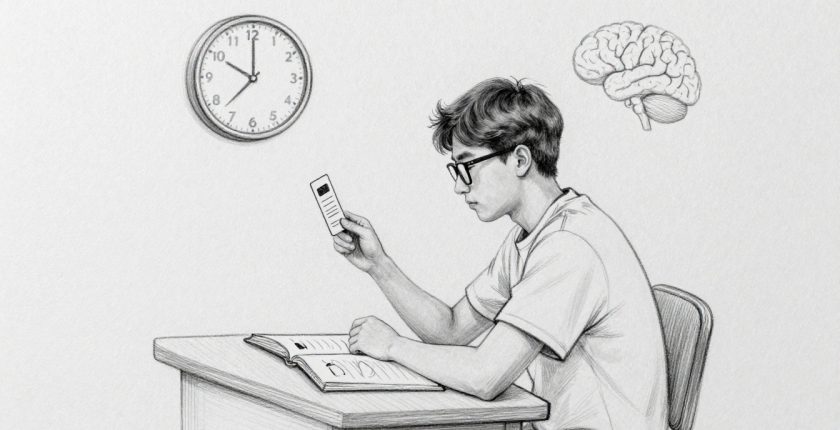
You can spend hours on passive studying, rereading notes, then sit in front of a test paper and watch familiar facts disappear. The problem often isn’t effort. Your brain has seen the material, but it hasn’t practiced pulling it out without a prompt.
Active recall means producing an answer before checking your notes. With repeated retrieval, correction, and well-timed review, these study techniques make answers easier to access when the clock is running.
Key Takeaways
- Active recall means producing an answer from memory before checking your notes, rather than relying on rereading or recognition.
- Use practice tests, flashcards, free recall, the blurting method, and the Feynman technique to strengthen retrieval and reveal weak spots.
- Match your practice to the actual test paper by rehearsing its question types, command words, timing, and level of detail.
- Follow each recall attempt with feedback, corrections, and a later retest so mistakes do not become the answers you remember.
- Space study sessions across several days and keep a mistake log to support long-term memory and improve recurring errors.
What Active Recall Is and Why It Can Improve Test Results
Active recall means trying to produce information from memory. You close the book, hide the answer, and answer a question on your own before checking your work.
That differs from rereading, highlighting, or watching an explanation again. Those activities can help you first learn material, yet they may also create an illusion of mastery. The page looks familiar because the answer sits right in front of you.
Learning researchers often call this retrieval practice or the testing effect, because testing yourself can strengthen learning. Carnegie Mellon University’s guide to retrieval practice explains that recalling information is a form of active learning that strengthens learning more effectively than simply reviewing it.
Active Recall vs. Rereading: What Changes in Your Brain
Suppose you’re studying the causes of the American Revolution. Rereading a chapter might feel smooth because names, dates, and events look recognizable. Instead, close the chapter and write down every cause you can recall.
That blank page can feel uncomfortable. However, it gives you honest information. You may remember taxation but forget colonial representation, trade restrictions, or the Boston Tea Party’s wider context.
The effort matters when you check your answer afterward. Retrieval shows the weak spots, while feedback fills them in before the test exposes them.

Why Retrieval Practice Helps With More Than Memorization
Recall practice isn’t limited to vocabulary and dates. A chemistry student can explain why a reaction shifts. A history student can compare two policies. A literature student can outline an argument about a character’s motives.
A 2021 review of classroom research examined 50 experiments involving 5,374 learners. Benefits appeared across ages, subjects, question formats, and delays before the final test. A recent review of retrieval practice also links it with stronger retention and comprehension. Together, these findings suggest it can support academic performance, without guaranteeing higher results for every learner.
A missed answer is useful data only when you find out why it missed.
Active Recall Techniques for Exam Preparation
For exam preparation, use active recall by answering practice questions before consulting your notes. Choose the method that fits the material, then make each question slightly harder than simple recognition.
Use Practice Tests and Past Exam Papers Like the Real Exam
Practice tests are one of the most direct ways to prepare for an exam. Use past exam papers from the correct course, exam board, or instructor whenever possible. Sit at a clear desk, set a timer, and complete each question without notes.
Afterward, mark your work with the official answer key, rubric, or teacher comments. Don’t only count points. Compare your response with exactly what each question asked.
For math, show every calculation step. For a science exam, label diagrams or explain processes without a word bank. For essay subjects, plan a thesis, evidence, and reasoning under the same time pressure you’ll face on test day.
Build Flashcards That Make You Think
Good flashcards ask one focused question. They don’t hold a shrunken textbook page on one side and a vague answer on the other.
Try prompts such as:
- “What are the three stages of cellular respiration, and where does each occur?”
- “How did the New Deal change the federal government’s role?”
- “What conditions must be true before using this geometry theorem?”
- “How does the author create tension in this scene?”
Say or write the full answer before flipping the card. Correct your response after the attempt, then separate missed flashcards into a review pile. Tools such as the Anki app can organize digital cards, but the quality of the prompt matters most.
Recognition, where an answer feels familiar after you see it, is weaker than producing it alone.
Try Free Recall, the Blurting Method, and the Feynman Technique
Free recall begins with a blank sheet. Write everything you remember about a topic, such as mitosis, supply and demand, or a novel’s plot. Then check your notes and add missing ideas in a different color.
Students often use the blurting method for this process. It works best when you organize the page around headings, processes, comparisons, or cause-and-effect links rather than disconnected fragments.
The Feynman technique adds a useful test of understanding. Explain the topic aloud in plain language, as if teaching a younger student. When your explanation turns foggy or relies on textbook phrases you can’t unpack, turn that gap into a new study question.
Mix Multiple-Choice Questions With Short Answers
Multiple-choice questions can help, especially when you explain why each wrong option is wrong. Still, include short-answer work because it demands a fuller response.
For example, don’t only choose the correct formula in physics. Solve a new problem and show why that formula applies. In biology, draw and label a process from memory. In English, write a compact paragraph that connects evidence to an argument.
The retrieval-based learning strategies used in medical education follow the same principle: frequent, effortful recall gives learners a clearer picture of what they can use under pressure.
Across these methods, active recall works best when you answer before checking notes. Return to corrections later, and use them to guide your next questions.
Match Your Practice to the Actual Test Paper
Active recall works best when it resembles the performance your test requires. A stack of simple prompts can’t fully prepare you for a three-page essay, a data-response question, or a multi-step calculation.
First, look at the paper’s question types. Then build recall tasks around those demands.
| Test format | Useful recall practice |
|---|---|
| Multiple choice | Select an answer, then justify every option |
| Short answer | Write complete responses without prompts |
| Essay | Plan claims and evidence on a timer |
| Math or physics | Solve unfamiliar problems and show calculations |
| Diagram-based science | Draw, label, and explain each stage |
The goal isn’t to predict the exact question. You’re training the move it demands: selecting, explaining, calculating, comparing, or defending.
Rehearse Timing, Wording, and Marks
A test paper has its own rhythm. A five-mark question needs more than a one-word response, while a 40-minute essay needs a plan before polished sentences.
Read command words carefully. “Describe” asks for details. “Compare” asks for similarities and differences. “Evaluate” requires a judgment supported by evidence. During practice, underline the command word and decide what proof the marker needs.
Leave a few minutes to check your work. This final period can catch skipped units, weak evidence, unfinished explanations, and answers that never addressed the question.
How to Space Active Recall for Stronger Long-Term Memory
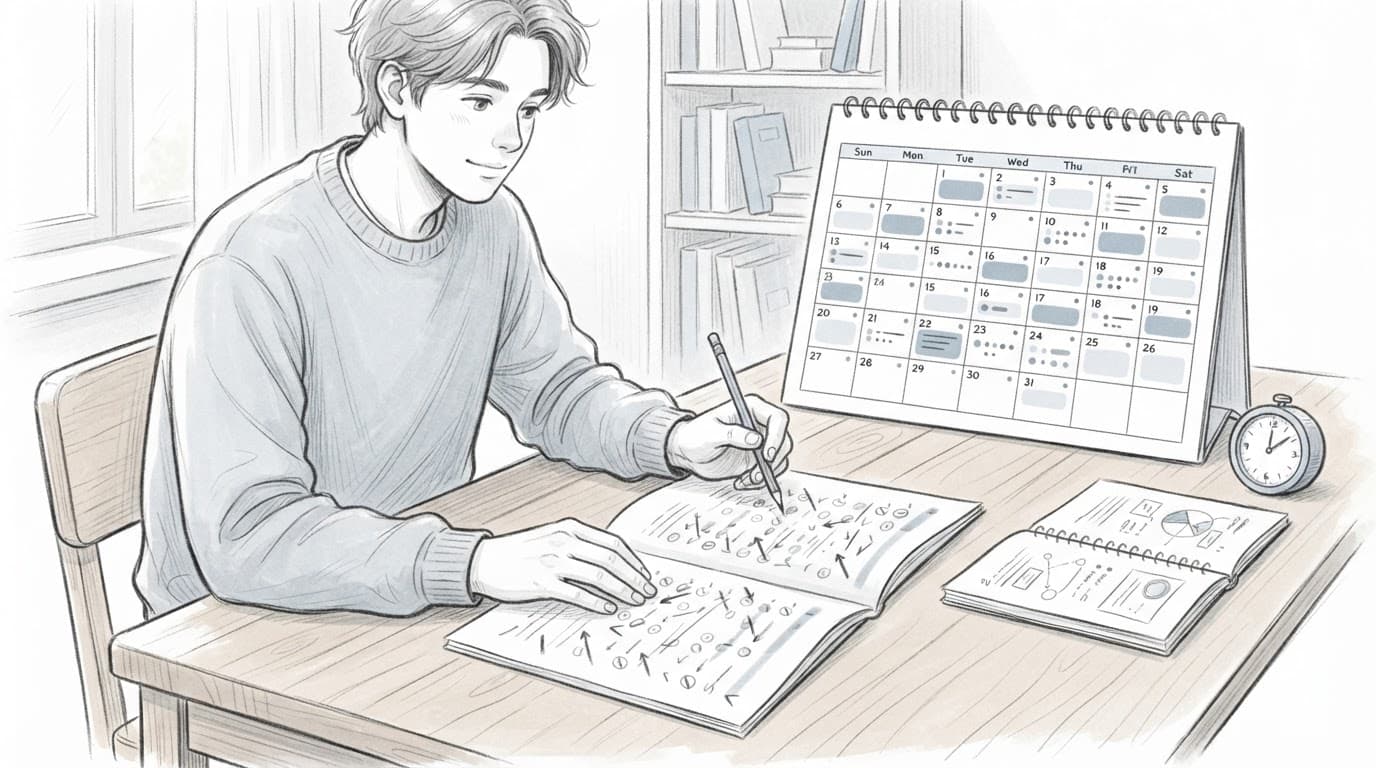
One long study night can help you finish an assignment. It rarely gives facts enough time to settle into long-term memory. Distributed practice gives each idea repeated chances to return, so space active recall across several sessions.
A practical starting schedule is simple: review on day 0, then after one day, three days, seven days, and fourteen days. Treat this as a starting point, not a rigid rule. Hard material may need closer review, while accurate answers can wait longer.
Research on retrieval practice finds that distributing recall across sessions beats packing it into one session. This approach supports memory retention by bringing information back after some forgetting has occurred. A plain-language review of active recall and spaced repetition evidence explains why delayed review and repeated recall work well together.
Use an Active Recall, Check, Correct, and Retest Cycle
Use the same loop each time you study:
- Answer a question without notes.
- Check against a reliable source, worked solution, or rubric.
- Correct the answer and identify the reason for the error.
- Retest that skill later without looking at the correction.
Feedback matters because a wrong answer shouldn’t become the version you remember. It stops an error from becoming the answer your memory retrieves later. If a teacher has marked prior work, use those comments. They often reveal patterns that a score alone hides.
Build a Study Routine That Fits Real Life
For a new topic, spend 20 to 30 minutes learning the material. Follow it with 20 to 30 minutes of recall prompts, free recall, or practice problems.
For review sessions, 10 to 20 minutes of recall can be enough. Add five to 10 minutes to inspect mistakes, then schedule the hardest items for the next session.
Several short sessions each week support distributed practice better than a single exhausted cram session. Put this study routine on your calendar like classes, practices, or work shifts.
Avoid These Active Recall Mistakes Before Your Next Test
Difficulty is part of recall practice. Blank moments don’t mean you’re bad at the subject. They show where the next round should begin, alongside other useful revision techniques.
Do Not Stop at Recognition or Read the Answer Too Soon
Cover the answer. Write your response, say it aloud, or solve the problem before looking. Even a partial answer reveals whether you know the basic idea, the details, or neither.
If you peek after two seconds, your brain practices recognizing the answer instead of producing it. Give yourself a fair attempt first, especially with questions you tend to avoid.
Do Not Practice Only Easy Facts or Ignore the Test Format
Easy cards feel productive because they produce quick wins. Yet a test paper may ask you to interpret a graph, connect two ideas, or defend a position with evidence.
Include difficult questions every week. Rotate through calculations, diagrams, essays, and application problems based on your course. Active recall works best when practice resembles the thinking required on exam day.
Keep a Mistake Log Instead of Repeating the Same Errors
Make a brief record of missed questions. Include the topic, the error cause, the correct fix, and any time issue. “Forgot definition” needs a different response than “misread negative sign” or “ran out of time.”
Review the log before your next study block. Then answer a changed question from the same set of practice questions later. Copying the correct answer isn’t enough. You need proof that you can produce it again.
Frequently Asked Questions
What is active recall?
Active recall is the process of producing information from memory before checking your notes or an answer key. It can include answering practice questions, explaining a concept aloud, or solving a problem without prompts.
Is active recall better than rereading?
Active recall usually gives you a clearer picture of what you can actually remember and use. Rereading can help you learn material initially, but it may create familiarity without proving that you can retrieve the answer independently.
How often should I use active recall?
Use active recall in short, repeated sessions instead of relying on one long cram session. A practical schedule is to review on day 0, then after one, three, seven, and fourteen days, adjusting the timing based on how well you remember the material.
What should I do after getting an answer wrong?
Check the answer against a reliable source, identify why you missed it, and write a clear correction. Retest the same skill later with a changed question so you confirm that you can produce the answer rather than recognize it.
Can active recall help with essay and calculation questions?
Yes. Plan arguments, explain evidence, solve unfamiliar problems, and show calculation steps without looking at your notes. Practice should match the thinking, wording, and time pressure required by the actual test.
A Better Way to Prepare for the Next Test
Hours of passive rereading can leave you with familiar pages but no answers when you need them.
Start small with one five-question quiz or one free-recall page. Then repeat that practice across the week and make it resemble your real test paper.
Use active recall to retrieve first, check your work, correct weak spots, and return after a delay. Consistent retrieval can support stronger test scores, though it can’t guarantee a particular result. It’s one of the most useful study methods for producing answers under pressure.