
Blog
Creative Writing Exams: How to Structure Your Answer
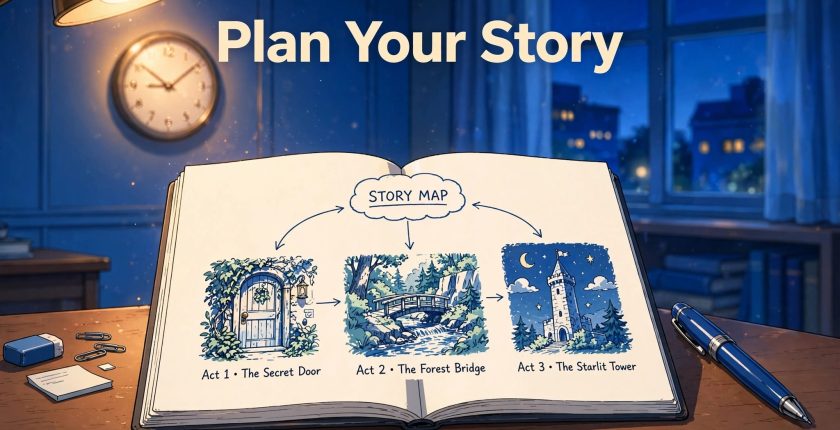
A promising story can lose its direction when the clock starts ticking. In creative writing exams, a brief plan helps you turn ideas into a complete response rather than a rushed opening with no ending.
You need clear direction, manageable content, and enough time to check your work. Start by identifying what the prompt requires, then choose a structure that fits it.
Key Takeaways
- Follow the exact task, including any required opening, image, topic, or word limit.
- Plan a small number of connected events, or a clear route through a descriptive scene.
- Keep viewpoint and tense consistent, vary sentences deliberately, and protect time for checking.
A flexible plan gives you something to follow without deciding every sentence before you begin.
Read the Prompt Before Choosing Your Structure
Identify the task, not just the topic
A question about an abandoned building might request a description, a story, or an opening chapter. Each needs a different shape.
A narrative develops events through cause and effect. A description can develop through changes in focus, atmosphere, or perspective without introducing a dramatic incident.
Underline the instruction and any required details. Then summarise the task in a few words, such as “describe an unsettling place” or “tell a story about a discovery.” Practising how to read an exam paper helps you spot restrictions before committing to an idea.
Check your exam’s expectations
Look for the intended audience, required format, and stated length. If the question supplies an opening sentence, your response must connect logically to it.
Assessment requirements differ between qualifications. For example, Cambridge’s B2 writing assessment guide addresses B2 First for Schools, rather than every English examination.
Use your own exam board’s current guidance and mark scheme. Don’t assume another qualification’s word limit or writing options apply.
Make a Short Plan for Creative Writing Exams
Limit the story’s scope
Choose one main character, a manageable setting, and one central difficulty. Several locations, lengthy histories, and numerous characters create more continuity problems than you can comfortably solve under pressure.
Write keywords rather than polished sentences. Your plan should record what changes and why.
For descriptive writing, note a route instead: a wide view, a closer detail, then a shift in atmosphere. Choose details that support one dominant impression rather than cataloguing everything visible.
Decide the ending before drafting
Know where the response is heading. Your character might make a decision, discover something, or see a familiar situation differently.
Then work backward to identify the details that make that ending believable. This prevents an unrelated twist appearing because time is running out.
For a 40-minute practice task, you could try four minutes planning, 31 minutes writing, and five minutes checking. Adjust that split during practice according to your speed and the actual exam requirements.
Example
A student searching for a lost key must decide where to look and whom to ask. Each choice changes the search.
| Stage | Main event | Structural purpose |
|---|---|---|
| Opening | Lena discovers her house key is missing after school. | Establishes the problem and what Lena needs to do. |
| Complication | She retraces her steps to the classroom but finds the classroom locked. | Blocks her first plan and raises the pressure. |
| Development | Lena asks a friend for help and checks the places they visited together. | Turns her search into a sequence of connected actions. |
| Turning point | Her friend remembers Lena lending the key to the caretaker. | Reveals a clue that changes where Lena looks. |
| Resolution | Lena retrieves the key from the caretaker and heads home. | Resolves the problem through the earlier search. |
Each step follows from Lena’s choices and the information she gains. In your own plan, connect obstacles to decisions so the next event feels earned.
Give the Opening and Ending Clear Jobs
Begin close to the important moment
An opening needs to orient the reader, but it doesn’t need a character’s entire biography. Establish enough information to understand the immediate situation.
Start near the event that matters. Then reveal relevant background as the story develops.
If your exam provides a first sentence, continue its tense, situation, and implications rather than treating it as decoration. This B2 story-writing guide discusses connecting a supplied opening with required story elements. Check whether those requirements match your paper before applying them.
Make the ending follow the development
A satisfying ending answers the main uncertainty or changes how the reader understands it. It doesn’t have to solve every problem.
However, it should follow the choices and details already established. An unexplained rescue or sudden new character can weaken the connection between your development and conclusion.
For description, return to an earlier detail with a changed atmosphere or altered focus. You don’t need to invent a disaster simply to create an ending. A deliberate final image can complete the response.
Maintain Coherence Across Paragraphs
Coherence means the reader can follow what happens, where it happens, and why it matters. Before starting each paragraph, decide what it adds.
A new paragraph can signal a change in time, place, speaker, or focus. It can also slow the reader at an important moment. However, random paragraph breaks won’t create meaningful structure.
Keep your viewpoint consistent. A first-person narrator can describe their own thoughts, but another character’s private feelings usually require observable evidence or explanation.
Similarly, maintain your main tense unless a clear time shift requires a change. Use brief signals such as “earlier that morning” when returning to a previous event.
A surprising ending still needs preparation. Introduce the information that makes it believable before the final paragraph.
During practice, create a reverse outline: summarise each completed paragraph in a few words. If the sequence reveals repetition or an unexplained jump, revise the structure before polishing vocabulary.
Vary Sentence Structure With Purpose
Match sentence rhythm to the moment
Longer sentences can develop a setting, connect actions, or delay important information. Shorter sentences can give an action more emphasis.
Avoid making every sentence the same length. Also vary openings: begin some with the subject, others with a time phrase or subordinate clause. Choose the pattern that makes the relationship between ideas clearest.
Keep accuracy ahead of complexity
A long sentence only helps when its meaning remains clear. If you repeatedly join complete sentences with commas, split them or use an appropriate conjunction.
Dialogue should reveal something or move the scene forward. Avoid lengthy conversations that consume time without changing the situation.
For targeted practice, the US Department of State’s Writing Skills Practice Book for EFL includes story-writing activities involving past-tense verbs and quoted speech. These are useful exercises, not requirements for every exam.
The English grammar practice materials can support work on recurring language errors between timed attempts.
Protect Time for a Final Check
Checking matters because an otherwise clear response can contain missing words, inconsistent names, or a sentence that never finishes.
Use your remaining minutes in this order:
- Check task fulfilment: confirm that you followed the instruction and included every required element.
- Check continuity: look for unexplained changes in character, location, viewpoint, or tense.
- Check accuracy: repair incomplete sentences, punctuation problems, and obvious spelling errors.
Read the opening and ending together if time is especially short. They should belong to the same response and address the same central situation.
During practice, revise structure before grammar. There’s little value in perfecting a paragraph you’ll later remove. In the exam, make small, clear corrections rather than attempting a complete rewrite.
Also check any explicit word limit using your exam’s permitted approach. Don’t rely on advice from a different qualification.
Practise the Process, Not a Memorised Answer
Creative writing exams reward your ability to respond to the task in front of you. A prepared story becomes a problem when you force it into unsuitable instructions.
Use past questions from your current course. Practise some complete responses, but also rehearse individual skills: planning an unfamiliar prompt, drafting an opening, or rewriting a weak ending.
A 25-minute study block could focus on one finished task rather than vague “English revision.” Spread these attempts across several sessions so you can apply feedback.
Afterward, compare your response with the relevant criteria. Ask a classmate to identify confusing moments, then make a separate editing pass. Learning how to review practice papers helps turn feedback into a specific next task.
Keep a brief error log and retest the weak skill with a different prompt. That checks whether you can apply the improvement beyond one corrected answer.
If you need individual feedback, a tutor can help you practise structure and accuracy at your pace. Find your tutor here.
Frequently Asked Questions
How many paragraphs should I write?
There’s no universal number. Paragraphs should reflect changes in action, time, speaker, or descriptive focus.
Use the task’s length and your exam guidance to judge development. A compact response may need fewer paragraphs than an extended narrative, but each paragraph should contribute something distinct.
Can I use flashbacks or an unresolved ending?
Yes, when they suit the prompt and remain clear. A flashback needs an obvious time shift and a reason for interrupting the present action.
An unresolved ending should still complete the response’s main movement. Under time pressure, straightforward chronology is often easier to control.
Finish With a Clear, Complete Response
A strong exam response starts with understanding the task and choosing a manageable direction. Connected development helps your ideas hold together when time is limited.
Practise planning, drafting, and checking as separate skills. Then combine them under realistic conditions, using a structure that supports the prompt rather than forcing the prompt to fit your structure.
If you choose to purchase a product or service through one of these links, we may receive a commission at no additional cost to you. Any recommendations are provided for informational purposes only.