
Blog
Mathematics Revision Strategies for Students That Stick
You can study math for hours, recognize every formula on the page, and still freeze when a new problem appears. The issue usually isn’t effort. It is that rereading notes does not rehearse the decisions you must make under pressure.
Effective mathematics revision strategies for students combine recall, practice, feedback, and later review. They help with homework, classroom tests, GCSE-style papers, and other assessments because they train you to choose a method, not merely remember a page.
Mathematics Revision Strategies for Students That Actually Work
A useful revision loop is simple: retrieve a method from memory, check your answer, correct the error, and return to that skill later. Solving problems gives you evidence of what you can do, while highlighting notes only shows what looks familiar.
Good math revision also builds habits that matter in tests. You need to identify the topic, select a method, show clear working, and decide whether your final answer makes sense.
Start With a Topic Checklist, Not a Vague Study Goal
“Math” is too broad to plan well. Break your course into specific pieces, such as fractions, linear equations, simultaneous equations, circle theorems, probability, quadratic graphs, and transformations.
Add test dates beside each topic. Then rate every item by confidence, importance, and urgency. Mark topics as new, developing, or secure. This directs time toward real gaps instead of filling every session with familiar questions.
A secure topic still needs occasional review. However, a weak topic usually needs several shorter visits across the week.
Use Active Recall Before Looking at the Method
Active recall means producing an answer before you check notes, a formula sheet, or a worked solution. Close the book and write the steps for solving a quadratic equation. Draw a geometry diagram from memory. Explain why a formula fits the question.
The discomfort is useful because it reveals the exact step that has disappeared. A plain-language explanation of active recall for math makes the same distinction between retrieving mathematical logic and passively recognizing it.
Try blurting for a topic such as probability. On blank paper, write every rule, diagram, and common mistake you can remember. Next, compare it with your notes and turn missing details into questions for another day.
Learn From Worked Examples, Then Solve Without Help
Worked examples are helpful when a topic is new or confusing. First, follow one clear example line by line. Cover it, then recreate the process without looking. After that, solve a similar question independently.
Change the numbers or wording for the next attempt. That small change tests whether you understand the method rather than memorizing a route through one question.
If you cannot make a sensible start after about 20 seconds, check the method briefly. Then immediately try a similar problem. Don’t spend ten minutes staring at a blank page, but don’t copy the solution before you have attempted the first move.
Build a Math Revision Schedule You Can Keep
A full timetable that ignores homework, sports, meals, travel, sleep, and rest will not last. Put fixed commitments on the calendar first, then use the genuine gaps for short, focused sessions.
Three weekday blocks of 20 to 30 minutes, one mistake-review session, and a 45 to 60 minute weekend mini-test can be enough to create momentum. Leave catch-up space, too. A missed session should be moved, not treated as proof that the plan has failed.
Space Practice Across Several Days
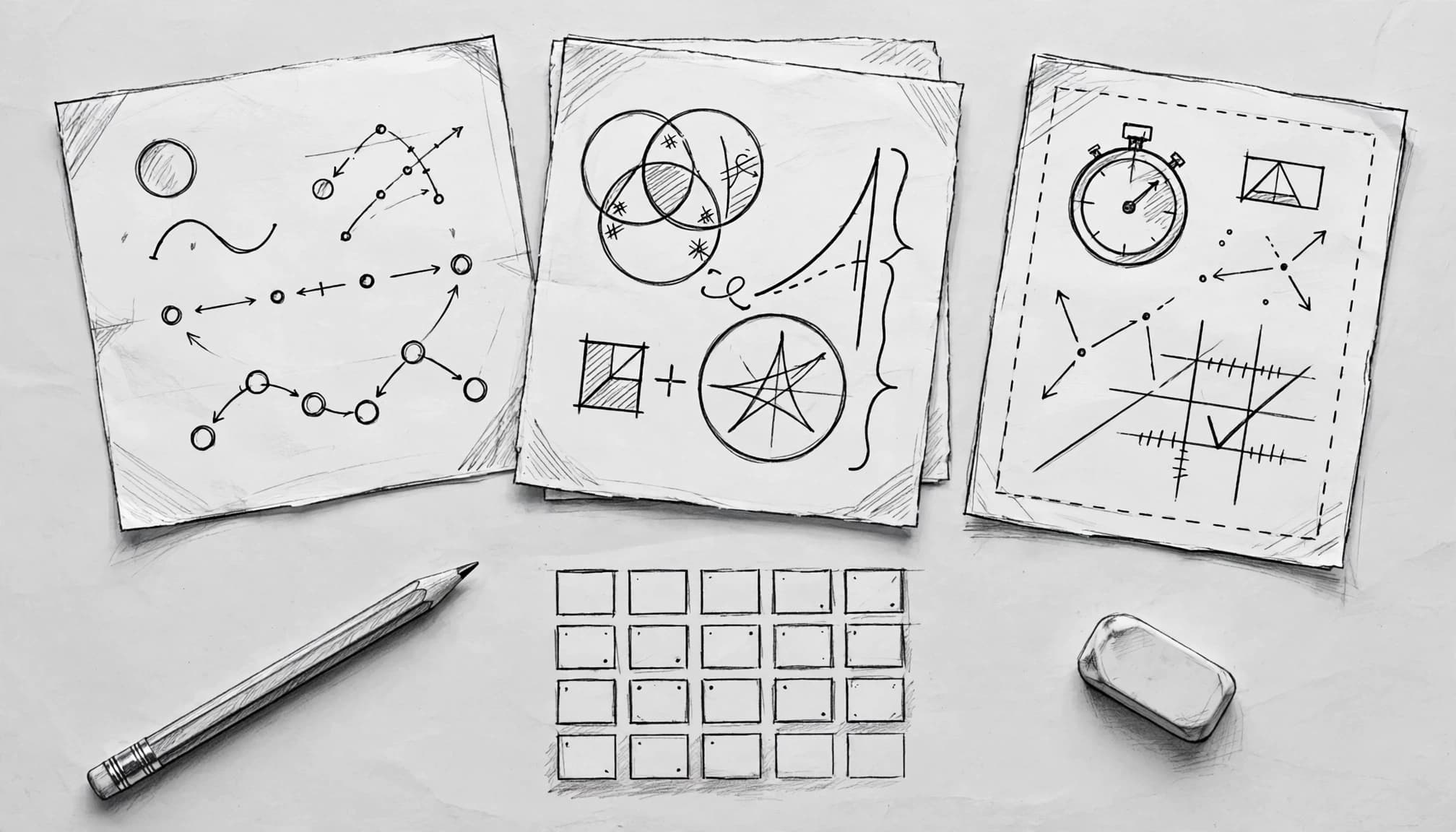
Returning to a topic after some forgetting makes recall work harder. Instead of doing 40 fraction questions on one night, solve a few today, a few in two days, then revisit them the following week.
A flexible pattern is day 1, day 3, day 7, and day 14. Harder skills may need an earlier return. The 2357 spaced-repetition method also uses growing intervals between reviews, which can help students avoid leaving a topic untouched for weeks.
During each return, retrieve the method first. Then answer a few questions and finish with a mixed mini-test later in the week.
Mix Topics to Practice Choosing the Right Method
Interleaving means mixing topics instead of completing a large block of identical questions. A session might include linear equations, area of circles, and probability. Three topics are usually enough for a short study block.
Mixed practice feels harder because the question does not announce the method. You must decide whether to factor, substitute, draw a graph, use a probability rule, or take another route. That decision is exactly what unfamiliar exam questions demand.
A guide to active recall and spaced repetition also recommends short, repeated reviews. Keep the questions varied, but do not mix so much that every topic becomes a rushed glance.
Write the Method Into Every Study Block
Specific calendar entries remove the struggle of deciding where to start. Write “fractions, five retrieval questions” or “circle theorems, mixed exam questions” instead of writing only “math.”
Match the activity to the goal:
- Use flashcards, blurting, or brief explanations for formulas, definitions, and conditions.
- Study one worked example before independent practice when learning a new skill.
- Choose problem sets for fluency, then use timed questions as a test approaches.
A session with a clear action is easier to begin and easier to review afterward.
Turn Mistakes Into Your Most Useful Revision Material
A wrong answer helps only when you discover why it happened. Keep a short mistake log with the topic, question type, error cause, correct method, and a similar question to attempt later.
After marking work, redo the question without copying the answer. Then return to the same skill after a gap. Research collected in a review of spaced repetition links repeated, distributed practice with stronger learning across memory and problem-solving tasks.
Separate Method Errors From Careless Slips
Different errors need different fixes. “Used the wrong formula” points to a method gap. “Lost a negative sign” calls for slower checking and more practice with similar calculations.
Use simple categories:
- You misunderstood the method or could not choose one.
- You selected the wrong formula or theorem.
- You made an arithmetic, sign, or transcription error.
- You misread a word, unit, or condition.
- You ran out of time before completing the question.
A correction only counts when you can solve a changed version later without seeing the original answer.
This turns a mistake log into a map for the next revision session.
Use Mark Schemes to Improve More Than Your Score
A mark scheme shows more than the number of points you earned. Compare every line of your solution with the expected method. Check whether you showed enough working, used correct units, labeled a diagram, and answered the exact command in the question.
For reasoning questions, look for the missing link in your explanation. For graph questions, check scale, labels, and plotted values. Rewrite unclear solutions neatly, then record patterns that keep appearing.
The goal is not to imitate the wording of a mark scheme. It is to make your mathematical reasoning visible to the marker.
Prepare for Math Tests With Exam-Style Practice
As the test gets closer, move from single-topic questions toward mixed and timed work. Use papers that match your actual course, level, exam board, calculator rules, and question format whenever possible.
Complete the paper in realistic conditions. Then mark it carefully, target the weak skills, and retest those skills later. Starting another full paper immediately often repeats the same mistakes before you have fixed them.
Practice the Question Types You Will Actually Face
Include short quizzes, mixed problem sets, multi-step calculations, graphs, reasoning questions, and full past papers. Each format asks for a different response, even when the underlying topic is the same.
Read what the question asks before calculating. A question may require an estimate, a proof, a labeled diagram, an explanation, or an exact value. Practice selecting a method, showing the calculation, and checking whether the final answer is reasonable.
Resources such as RevisionDojo’s active-recall exam guidance emphasize using question-bank practice alongside recall. For mathematics, the strongest version of that practice is a new question that forces you to make the method choice yourself.
Build Timing and Checking Into Practice Papers
Work under a time limit often enough that the clock feels familiar. Use the number of marks as a guide to how much working and time a question deserves.
Underline key words, move on when you are stuck, and return to skipped questions. Save a few minutes at the end to check signs, units, rounding, copied numbers, calculator entries, and unfinished working.
Repeated timed practice reduces surprises. It also shows whether the main issue is content knowledge, slow methods, or losing marks through rushed checking.
Avoid Revision Habits That Feel Productive but Waste Time
Rereading notes can help you begin a new topic, but it cannot replace retrieval. The same is true of memorizing formulas without knowing when they apply, copying worked solutions, or completing only easy questions.
Cramming the night before creates a long session but leaves little time for later retrieval. An overfilled timetable creates another problem because it makes one missed block feel disastrous.
Keep revision active and adjustable. Include harder questions, feedback, breaks, and sleep. Once a week, review what you finished, move unfinished work forward, and schedule weak topics before they fade again.
A Routine You Can Repeat
The most reliable routine is modest: choose a specific topic, retrieve before checking, learn from examples, space your reviews, mix problem types, and use mistakes to plan the next session. Timed exam questions then show whether the method holds up under pressure.
Start with one weak topic today. Complete five questions without notes, check every step carefully, and schedule the next review before you close your notebook. Steady practice matters more than a perfect timetable or one late-night study session.