
Blog
How to Find Past Papers That Match Your Syllabus
A past paper can look perfect until you discover it tests the wrong course. If you’re searching for syllabus past papers, downloading one is only the first step. Check the syllabus version, paper format and assessment language to choose useful practice for exam preparation.
A well-matched paper shows you what to practise. A paper with the right title but wrong course can send you towards topics you won’t be examined on. Start with your current course document, then use its curriculum details to search for and verify each paper.
How to find syllabus past papers that fit
Before opening an archive, write down the identifying details of your exam. A subject name alone is rarely enough: “History” could refer to different qualifications, syllabuses or university modules.
Record the exact qualification and code
Check your teacher’s course outline, exam timetable or current curriculum document. Note the awarding body or university, subject, qualification level, syllabus or course code, and the academic year of your exam. If your course has separate components, record the paper numbers too.
For example, Cambridge International AS & A Level History uses the syllabus code 9489. At a university, the useful identifier may be a module code rather than a broad subject title. The University of Queensland (UQ) gives ENGG1500 as an example of a course code students can search.
Search with the code, then narrow the results
Enter the exact code into the official archive first. If that fails, try a partial code or combine it with a distinctive subject title. To find past exam papers from an awarding body, add the qualification and paper number. For a university search, add the course code and academic year.
Open the result rather than trusting its search snippet. Check the first page of the question paper for the subject, level, session and component. Keep a note of those details so you can find its marking material later.
Check the paper against your current syllabus
A matching code is a strong start, but it doesn’t settle every question. Courses and curricula change, and older papers may use different content or assessment rules.
Compare content and assessment format
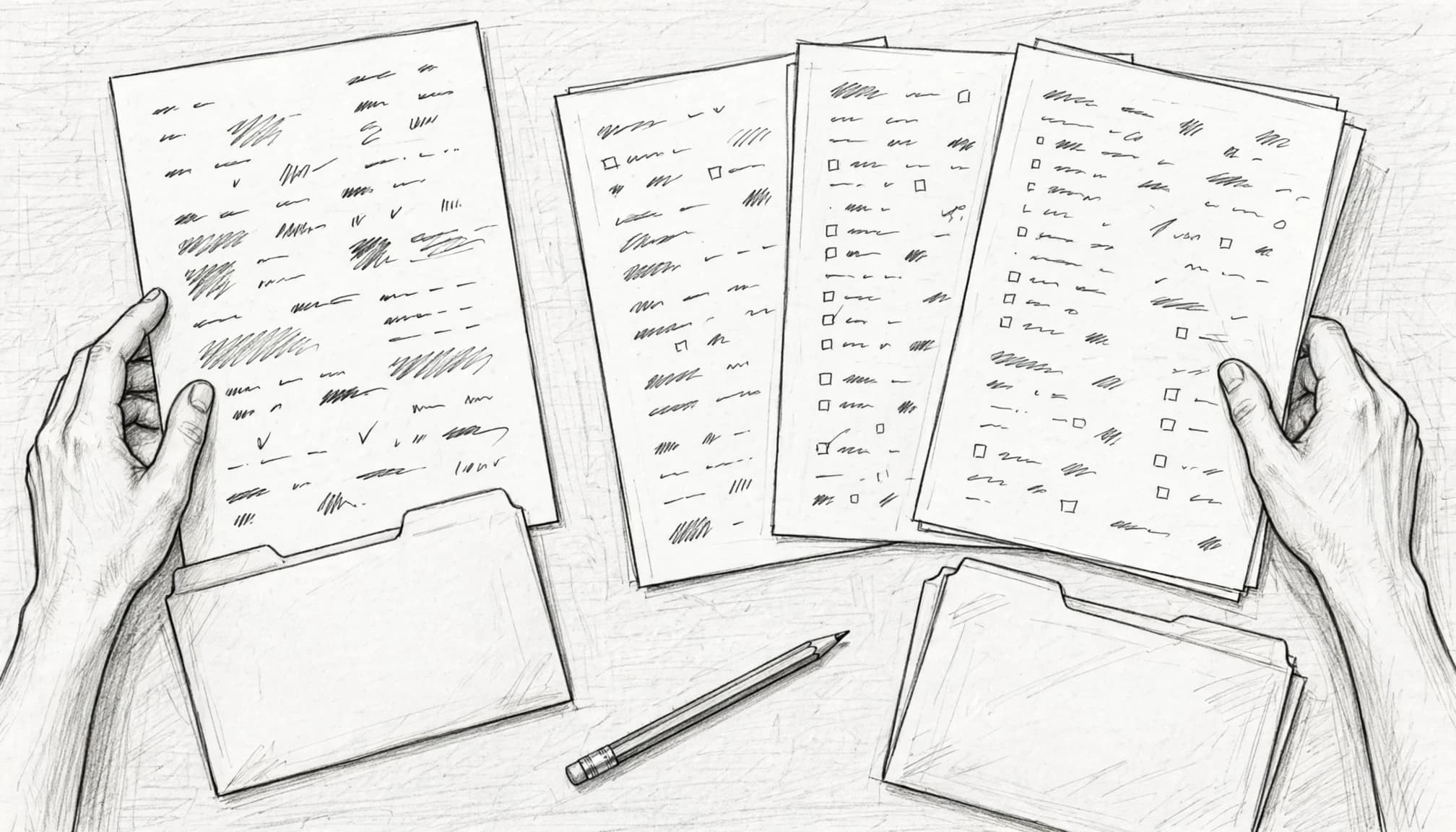
Put the paper beside your current syllabus. Check whether its topics, required texts, practical skills and assessment objectives still apply. Then compare the time limit, total marks, permitted equipment and question types.
Also check details that are easy to overlook: foundation or higher tier, language version, optional units and paper variant. A question can cover a familiar topic yet use a format you won’t face. Cambridge International cautions on its past-paper pages that some older question papers may not reflect the current syllabus.
Selected questions from topical past papers may still help after a course change. Use them only when you can identify the skill they test, not as a guide to current topic coverage or mark allocation.
Use sample papers when the course has changed
If your specification was recently revised, look for official specimen material or a sample exam. It shows the intended format for the newer syllabus, even when few live papers are available.
Ask your teacher which older components remain useful. Practice papers can help you work on an unchanged calculation or source-analysis skill, but don’t use an entire old paper for mock exams if it doesn’t reflect current conditions. For South African Grade 12, make the same check against your current CAPS subject documents before relying on older NSC papers.
Start with official exam-board sources
Official awarding-body pages are the safest starting point for question papers and marking guidance. They identify the qualification and usually group assessment materials by exam session.
Pair each paper with its marking material
The Pearson past-paper search provides question papers and mark schemes. On the Cambridge History 9489 past-paper page, students can find past papers alongside mark schemes.
Download the matching documents together. Check that the scheme refers to the same session, component and variant as your paper. Examiner reports can add context by explaining common mistakes, but they don’t replace the mark scheme.
Recognise access limits
A search result doesn’t always mean you can download every document. Pearson says its past-paper service is free to students and teachers, while papers sat within the past 12 months are available only to teachers.
Use older public papers or official sample material while you wait for a release. If you’re unsure what your school can share, ask your teacher rather than trying to obtain restricted files from an unofficial upload. You can also check Cambridge’s student practice resources for syllabuses, specimen papers and other published learning resources.
Search university libraries by course code
University archives differ from exam-board sites. A library may hold past exam papers without an answer key, and its collection depends on what departments have supplied.
Use the library’s own search
The UQ past-paper search works as a library search for full or partial course codes. That helps when you know the course family but aren’t sure of the complete code. Still, check the result against your current course outline: a similar code doesn’t guarantee an identical module.
The University of Edinburgh’s Exam Papers Online is another library search option. It includes most papers from academic year 2004/05 onward for university staff and students. Its coverage isn’t a standard for other libraries; each institution sets its own database access and archive arrangements.
Check what’s included
UQ explains that its archived PDFs contain original exam questions without answers. Your lecturer’s practice problems, tutorial solutions or feedback may be better for checking your work. Don’t assume an online “solution” belongs to the official paper just because its filename looks similar.
At either university, compare the archived paper’s year and course title with the version you’re taking. Modules can keep the same code even when teaching or assessment changes.
What to do when a paper is missing
Check whether the paper should be public yet, since release timing and archive retention affect when previous exams are available. UQ says papers are generally released three to four months after a semester ends. Edinburgh notes that papers from its most recent exam period may not yet appear online.
If an older UQ paper is missing, the course may not have run, the assessment may have used another format, or the School may have handled the exam. UQ Library’s past-paper guidance directs students to the relevant School for school-based or mid-semester exams and to UQ Examinations for exams more than five years old. Edinburgh asks users to contact its Exam Papers Online team about missing papers from previous academic years.
When you ask for help, include the exact course code, title, academic year, and exam session. Meanwhile, use an official specimen paper or lecturer-approved practice set rather than a paper from a different course.
Use third-party archives with a second check
Third-party archives can save time when you’re looking for topical past papers on a specific syllabus point. Platforms such as exam-mate offer topic-based practice and may include tools, such as an exam builder, for assembling custom exams. These learning resources can be helpful, but the official syllabus remains your reference.
Before using a question from an archive, trace it back to an exam board, session, and paper component. Check that the question has been copied accurately, its marks are intact, and the correct mark scheme is linked. A website’s topic label may cover more content than your current syllabus requires.
Prefer legitimate, freely available papers from awarding bodies, schools, and libraries. Be cautious with sites offering recently restricted papers or downloads with no clear source. If a platform advertises AI explanations, check the working against the official mark scheme or ask a teacher about disputed answers. A confident-sounding explanation can still miss the marks an examiner awards.
Turn matched papers into useful practice
Once you’ve found suitable papers, organise them by subject, year, session and component, and check that they match your current curriculum. Keep each question paper with its corresponding mark scheme or memo. That small habit prevents an avoidable mistake: marking a response against the wrong version.
Begin with weak topics
If one syllabus point keeps causing trouble, collect topical past papers from different years. For example, practise several data-response questions before sitting an entire science paper. Keep the original wording and mark values so the task stays close to the exam.
Attempt the questions without notes, then mark them. Record whether each lost mark came from missing knowledge, choosing the wrong method, misreading the instruction or leaving out required detail. Next, try a fresh question on the same skill. A high score on a question you’ve memorised tells you less.
Move on to full timed papers
When you can handle individual topics, mix them, then move on to full practice papers. Attempt a complete, compatible paper under its stated time limit, using only permitted materials. This tests how you switch between topics and manage longer answers.
Afterward, use the matching scheme and, where available, an examiner report as learning resources to review your work. Award marks for what you wrote, not what you meant to write. For an extended answer, ask a teacher to review anything you can’t judge fairly yourself. Use the errors to choose your next revision resources and practice questions, rather than treating the final percentage as a prediction.
Key Takeaways
- Identify your current qualification, syllabus code and paper components before searching.
- Verify each paper’s year, variant, content and format against the current syllabus.
- Start with official archives, and pair question papers with the correct marking material.
- Use topical questions to repair weak areas before moving to full timed papers.
- If a paper is missing or restricted, use legitimate alternatives and ask the relevant school, library or teacher.
Conclusion
Finding a paper is easy compared with finding one that tests your actual course. The syllabus code gets you close; checking the content, version and format tells you whether it’s worth your time.
Keep the right paper with its marking guidance, then use mistakes to select what to practise next. That turns a download into evidence you can use before the exam.
Frequently Asked Questions
Can I get official answers with every past paper?
No. Some awarding bodies publish mark schemes, while university archives may provide questions only. UQ, for example, says its archived exam PDFs don’t include answers. Check the original publisher before trusting a separate solution file.
Why can’t I open a recent paper?
Access depends on the publisher. Pearson restricts papers sat within the past 12 months to teachers. University papers may also take time to enter a library archive. Use publicly available older or specimen material rather than seeking a restricted copy.
Are old papers useful after a syllabus change?
Yes, if a question still tests a current topic and skill. Check the present syllabus and sample assessment first. Avoid using an old full paper to judge your readiness when its content or timing has changed.
Should I practise topical past papers or whole exams first?
Start with topical past papers when you know where you’re struggling. Once you can answer them without prompts, mix topics and try a full timed paper. Both approaches work best when the questions match your current syllabus.