
Blog
Why Is the Sky Blue? Light Scattering Explained
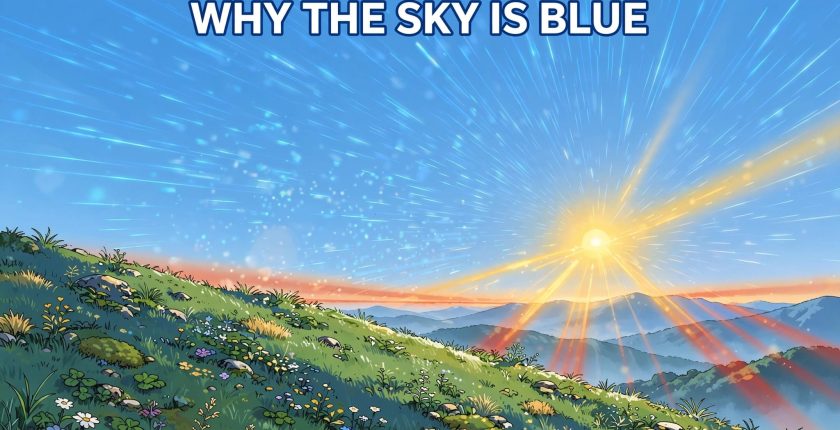
People searching “why is sky blue” are asking why a cloudless sky looks intensely blue while nearby air seems colorless. The answer lies in how sunlight interacts with air molecules.
Those molecules scatter some light in different directions, with shorter blue wavelengths scattering more strongly than longer red wavelengths. This scattering also helps explain why the sky changes color as the Sun approaches the horizon.
Start with what sunlight contains, then follow what happens when it enters the atmosphere.
Why is the sky blue?
Sunlight looks white, but it contains a mixture of visible colors. A prism can separate that mixture into a spectrum, showing colors that normally reach your eyes together.
As sunlight enters Earth’s atmosphere, it encounters molecules of gases, mainly nitrogen and oxygen. These molecules scatter some of the light, redirecting it away from its original path.
Blue light scatters more strongly than red light. Therefore, when you look at a clear patch of sky away from the Sun, blue-rich scattered sunlight reaches your eyes.
NASA’s explanation of blue skies describes this connection between shorter light waves and stronger scattering.
The atmosphere doesn’t simply reflect a blue surface, and the ocean doesn’t supply the sky’s color. Even above dry deserts or inland cities, a clear daytime sky can look blue.
The distinction between direct and scattered sunlight matters. Direct sunlight travels toward you along a path from the Sun. Meanwhile, scattered sunlight arrives from other parts of the sky.
Each direction you look samples light redirected by air along that line of sight. That’s why blue appears spread across the sky rather than concentrated around the Sun.
How Rayleigh scattering works
The process responsible for a clear blue sky is called Rayleigh scattering. It occurs when light interacts with particles much smaller than its wavelength, including air molecules.

What air molecules do to light
Light is an electromagnetic wave. Its electric field affects charged particles inside a molecule, causing them to respond to the passing wave.
That response sends some light outward in other directions. In ordinary language, the molecule scatters the light.
This interaction doesn’t turn red light into blue light. Instead, it changes the direction of some incoming light while preserving its color.
Although one molecule scatters only a small amount, the atmosphere contains an enormous number of molecules. Together, their scattered light becomes visible as the daytime sky.
The UCAR guide to sky appearance connects these molecular interactions with the colors we see overhead.
Why shorter wavelengths scatter more
A wavelength is the distance between successive peaks of a wave. Blue light has a shorter wavelength than red light.
For particles as small as air molecules, the electromagnetic interaction produces stronger scattering at shorter visible wavelengths. As a result, blue light is redirected more readily than red light.
All visible colors can scatter, however. The difference is how strongly they scatter, not whether they scatter at all.
You don’t need a formula to follow the relationship: shorter wavelengths undergo stronger Rayleigh scattering. That’s the physical reason blue light contributes so much to a clear daytime sky.
Why the sky isn’t violet
Violet light has an even shorter wavelength than blue light, so it scatters strongly too. Yet the sky usually looks blue because scattering strength alone doesn’t determine the color you perceive.
Violet is part of the scattered light
The light reaching you from a patch of sky contains a mixture of wavelengths. It isn’t a single, perfectly pure blue.
That mixture includes violet and other visible colors, even though we describe its overall appearance as blue. Naming the color doesn’t mean every other wavelength has disappeared.
This explains why “the atmosphere scatters only blue light” is inaccurate. Air molecules scatter a range of colors, with violet and blue among those scattered most strongly.
So the question “why is the sky blue?” needs an explanation of both atmospheric physics and human vision.
Your eyes influence the answer
Your eyes don’t respond equally to every visible wavelength. Human vision is more sensitive to blue light than to violet light.
Color-sensitive cells called cones respond to overlapping parts of the visible spectrum. Your brain combines their responses into the colors you experience.
Therefore, the wavelength that scatters most strongly doesn’t automatically become the color you see. The mixture of arriving light and your eyes’ sensitivity both matter.
For the clear daytime sky, that combination produces the familiar blue appearance. Violet contributes to the scattered light without making the whole sky look violet.
Why sunsets look red and orange
As the Sun approaches the horizon, its light passes through more atmosphere before reaching you. It encounters more air molecules along that longer path.
Those extra encounters scatter more violet and blue light out of the Sun’s direct path, so the sunlight that continues toward you is relatively richer in red and orange. This scattering, rather than reflection of the sky’s color, helps sunrise and sunset skies appear pink, orange, or red.

The same wavelength preference operates throughout the day. What changes is the amount of atmosphere sunlight crosses as the Sun’s position changes.
When the Sun is high, the path through the atmosphere is shorter. Near the horizon, the longer path gives molecules more opportunities to scatter the shorter wavelengths.
NOAA’s explanation of atmospheric color connects the blue daytime sky with the warm colors seen near sunset.
These changes don’t mean the Sun itself suddenly becomes orange or red. The appearance changes as sunlight travels through the atmosphere.
Sunrise follows the same broad principle because the Sun is also low in the sky. However, individual sunrises and sunsets vary with atmospheric conditions, so their colors won’t always match.
Why clouds and hazy skies look different
Air molecules explain the blue of a clear sky, but they aren’t the only things sunlight encounters. Water droplets, ice crystals, and suspended particles can change the sky’s appearance.
Why clouds usually look white
Cloud droplets and ice crystals are much larger than air molecules. They scatter visible colors more evenly, rather than strongly favoring blue through Rayleigh scattering.
When those scattered colors reach your eyes together, a sunlit cloud usually looks white. Its appearance comes from a broad mixture of visible light.
A thick cloud can look gray underneath because less sunlight reaches its lower layers. Its color depends partly on how much light reaches the part you’re viewing.
This is why a bright white cloud and a dark rain cloud don’t require different-colored water. Their lighting and thickness affect what you see.
Why the horizon can look pale
A clear sky often looks deeper blue overhead and paler toward the horizon. Looking toward the horizon means looking through a longer stretch of atmosphere.
Along that path, light can encounter more suspended particles and undergo additional scattering. Haze can add a whitish appearance that reduces the intensity of the blue.
The exact appearance depends on the air’s condition. A dry, clear day can look different from a humid or dusty one.
A pale horizon doesn’t mean that blue scattering has stopped. It means the light reaching your eyes has a different mixture.
Observe the sky without looking at the Sun
You can explore these ideas outdoors without specialist equipment. Choose a safe viewing position, and never stare directly at the Sun.
- Compare a clear patch of sky overhead with one near the horizon. Notice whether the overhead blue looks deeper.
- Look at a sunlit cloud beside clear sky. Compare the cloud’s white appearance with the surrounding blue.
- Observe the sky around sunrise or sunset while keeping the Sun out of your direct gaze. Notice where warm colors appear.
Use your own eyes first, then take photographs if you want a record. Phone cameras can adjust color and brightness automatically, so a photograph may differ from what you saw.
Record the time, cloud cover, and whether the air looks clear or hazy. Those details help you compare observations without treating every difference as a change in Rayleigh scattering itself.
If possible, repeat the observations from the same location on several days. Similar viewing directions make changes easier to notice.
If you’d like individual help explaining physics ideas or working through questions, Find your tutor here. Ask for practice that connects everyday observations with clear scientific explanations.
Frequently Asked Questions
Why does the sky look blue?
Air molecules scatter shorter blue wavelengths more strongly than longer red wavelengths. The scattered blue-rich light reaches your eyes from across the sky.
Why doesn’t the sky look violet?
Violet light scatters strongly too, but the light reaching you is a mixture of colors. Human vision is more sensitive to blue than violet, so the sky usually appears blue.
Why do clouds usually look white?
Cloud droplets and ice crystals scatter visible colors more evenly than air molecules do. Those colors reach your eyes together, making sunlit clouds usually appear white.
If you choose to purchase a product or service through one of these links, we may receive a commission at no additional cost to you. Any recommendations are provided for informational purposes only and do not affect the free nature of the courses.