
Blog
Turn Your Syllabus Into a Revision Checklist That Works
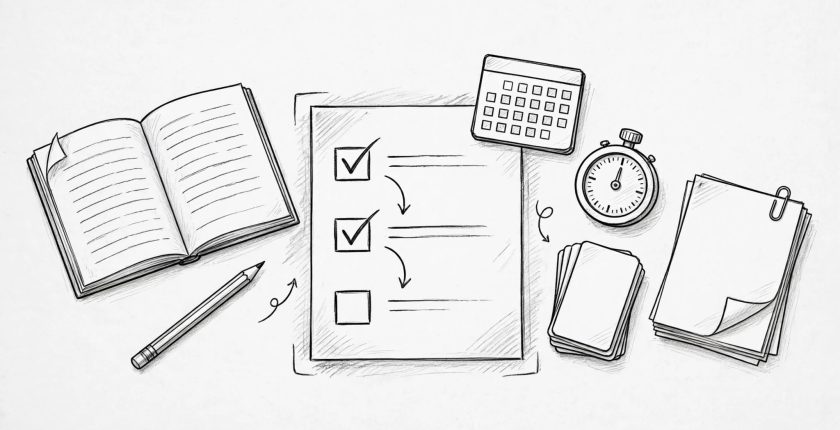
A syllabus can make exam revision feel larger than it is. It often lists whole units, broad skills, and assessment dates, but it doesn’t tell you what to do during a 40-minute study session.
A useful revision checklist turns those broad headings into small tasks you can finish, test, and revisit. It also shows which topics need attention first, so you don’t spend every evening reviewing material that already feels comfortable.
Start with the syllabus, then build a plan that reflects your exam dates, confidence, and available time.
Key takeaways
- Copy every examinable topic and skill from your syllabus into one master list before scheduling anything.
- Break each heading into tasks you can complete in one sitting, such as “solve ten simultaneous-equation questions” rather than “revise algebra.”
- Rank tasks by exam date, topic importance, and your current confidence level.
- Put a study method beside every task, including flashcards, practice questions, essay planning, or free recall.
- Return to difficult material across several days instead of saving it for one long session.
- Update the list after each session, using mistakes and timed practice to decide what comes next.
Read the syllabus like an exam planner
Your syllabus is more than a list of lessons. It usually tells you the content, skills, assessment format, and timing that should shape your revision.
First, collect the syllabus, assignment guidelines, assessment calendar, past papers, and topic lists from your teacher or lecturer. For essays or research assignments, gather the source material you may need to use. Keep everything together while you build your master checklist.
Mark what can be assessed
Highlight units, learning outcomes, required texts, formulas, case studies, practical skills, and command words. Phrases such as “analyse,” “evaluate,” “calculate,” “compare,” and “apply” tell you what you may need to do under exam conditions.
Also mark anything your course identifies as core, required, or heavily weighted. A topic that appears in several learning outcomes deserves more than a quick review.
Separate content from skills
A syllabus may say “understand photosynthesis” or “analyse historical sources.” Those statements combine knowledge with performance. A writing assessment may also test a writing process: planning, drafting, and improving an answer.
For example, a science unit might require you to recall a process, label a diagram, interpret data, and answer an unfamiliar application question. A history unit may require factual knowledge, source analysis, and timed essay structure. A writing task may require you to plan, develop, and refine a response. Each needs a different task on your checklist.
A topic is only ready to tick off when you can perform the skill the assessment demands, not when the page looks familiar.
Build a study checklist from syllabus wording
Copy each syllabus heading into a document, spreadsheet, notebook, or planning app. Then rewrite it as a set of clear actions. Every item should begin with a verb and lead to visible proof of work.
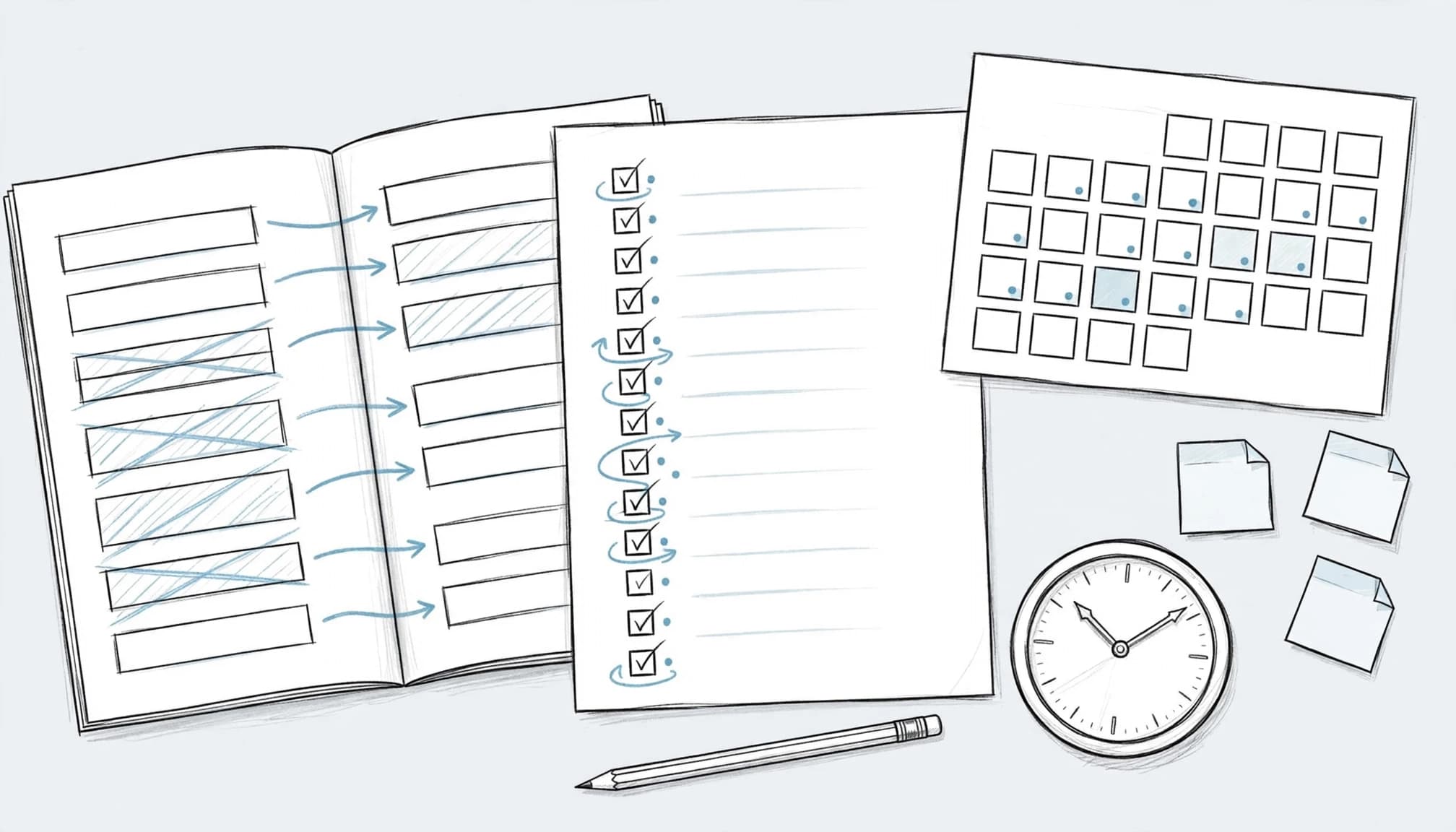
Turn broad topics into finishable tasks
“Revise chemistry” is too vague to start. “Answer six calculation questions on molar mass, mark them, and log errors” gives you a defined job and an endpoint.
Use tasks that fit into 20 to 45 minutes. If an item will take longer, divide it further. You can always combine short tasks later, but an oversized item often gets postponed.
Here is an example of how one syllabus statement can become a practical plan:
| Syllabus wording | Checklist tasks |
|---|---|
| Explain how a government policy changed society | Recall the policy’s aims without notes; make a cause-and-effect map; choose two pieces of evidence; write one timed paragraph; mark it against the course criteria |
| Solve problems using trigonometry | Review sine, cosine, and tangent conditions; complete worked examples; solve eight mixed questions without notes; check units and calculator settings; record errors |
| Analyse a novel’s themes and methods | Identify the plot structure, character development, and narrative voice; recall key scenes for one theme; select quotations; explain language choices; create an essay plan from a past question; write a timed introduction |
The checklist tasks show what “revision” looks like. They also create useful evidence, such as a marked response, completed problem set, or recall page.
For writing-based subjects, use the same approach with academic skills. Identify the main idea and target audience. Write a topic sentence and one-sentence thesis statement. Check whether body paragraphs support the argument. Match three claims with citations and explain the evidence and analysis for each one.
Add a clear definition of done
Each task needs a completion rule. “Read notes on cell division” doesn’t prove much. “Draw and label mitosis from memory, then correct missing stages” does.
For writing assignments, produce a rough draft before improving it. Create a reverse outline to check its structure against the intended argument. Then complete editing and revising, followed by peer editing when a classmate or study partner is available.
Your wording should make procrastination harder. If you can tell exactly how to begin, you are more likely to begin.
Prioritize by date, confidence, and importance
A complete list can feel intimidating, especially when several subjects share the same exam period. Prioritizing prevents the checklist from becoming a record of everything you hope to do.
Give each task three quick ratings: when you need it, how confident you feel, and how important it is to the assessment. You don’t need a complicated scoring system.
Put upcoming assessments first
Write every exam date, coursework deadline, practical assessment, and mock exam beside the relevant topics. Then work backward to reserve enough sessions for learning, retrieval, practice, and correction.
A topic tested next week usually comes before one tested next month. However, don’t abandon later exams entirely. A short weekly recall session protects older material from fading.
Let weak areas take more space
Use a simple confidence label such as secure, developing, or weak. Be honest. A topic you recognise in your notes may still be weak if you cannot explain it or answer a question without help.
Give weak, important topics repeated slots. Secure topics need shorter check-ins, not daily rereading. If a practice question exposes a gap, change its confidence rating immediately and move it forward in the plan.
Schedule study sessions you can keep
A checklist becomes useful when it reaches your calendar. Start by adding fixed commitments, including classes, work, travel, sport, meals, assignments, and family plans. The remaining gaps show your real revision time.
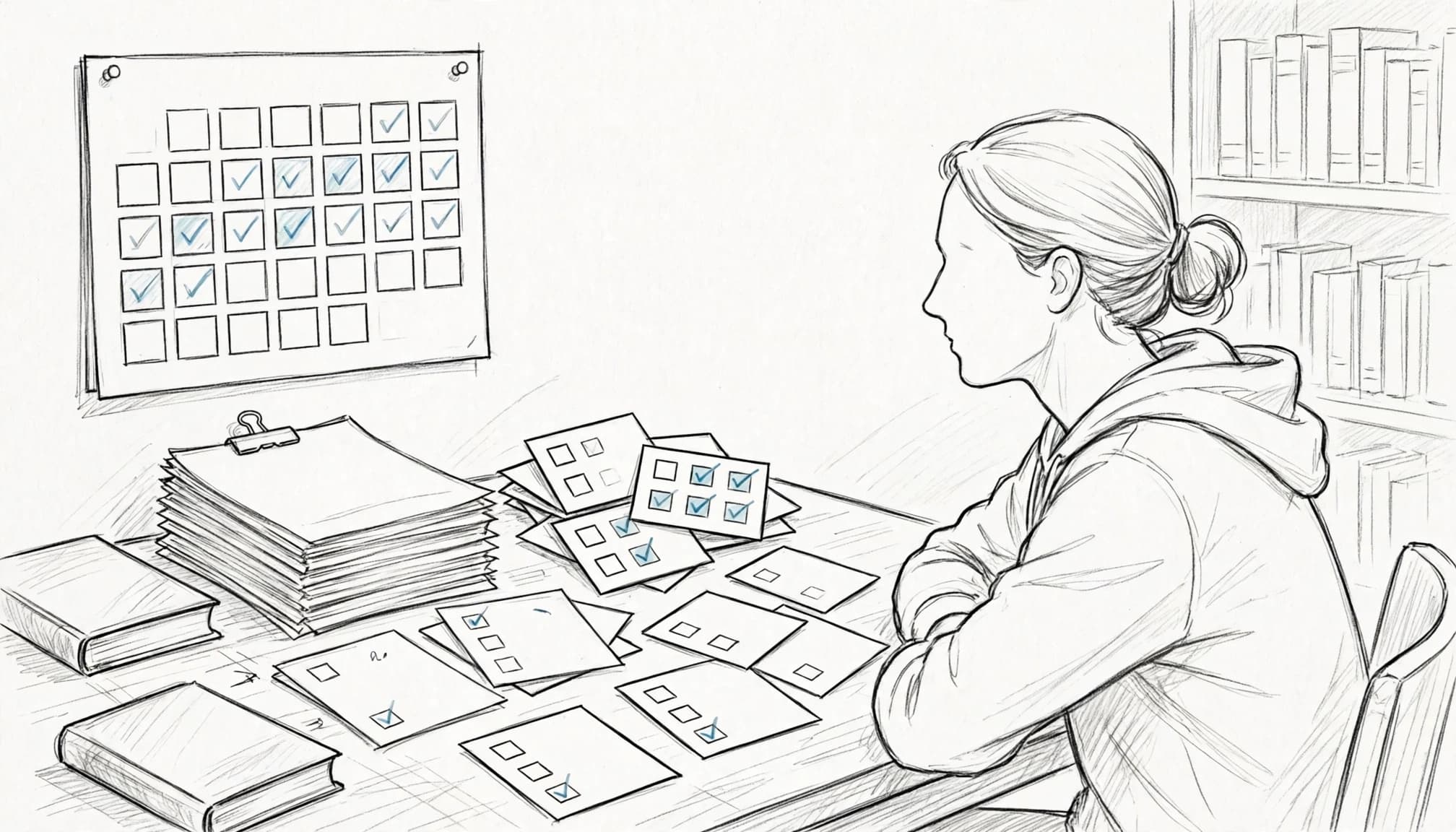
Give every block a method
Write both the topic and the activity. “Biology” leaves you deciding what to do after you sit down. “Biology, 25 minutes of flashcards, then 20 minutes of diagram recall” gives the session a starting point.
Match the method to the assessment:
- Use flashcards, self-quizzes, or free recall for definitions, dates, vocabulary, and processes.
- Solve unfamiliar problems and show every step for maths, physics, and quantitative subjects.
- Build timed plans, select evidence, and write short responses for essay-based exams.
- Use past papers to rehearse command words, mark allocation, timing, and answer length.
For an essay, schedule the writing process as separate blocks: one to produce a rough draft, one for peer review, and another for peer editing. Reserve a final block for editing and revising after feedback. If you need extra support, book a writing center appointment as an optional block for help with the essay or assignment.
A balanced school-night session might include 40 minutes on a difficult topic, a 20-minute break, 35 minutes of practice questions, and 20 minutes of lighter flashcard review.
Leave room for life and catch-up
Avoid filling every available minute. A missed session is a planning issue, not a reason to discard the whole timetable.
Leave at least one catch-up block each week. Protect breaks and sleep as well. Long, exhausted evenings often produce less useful recall than several shorter sessions completed across the week.
Choose one system, whether that is a paper planner, calendar, spreadsheet, or study app. Digital calendars can send reminders and make it easy to move a session. Paper can give you a clearer view of the week. Switching systems repeatedly makes completed work harder to track.
Use the checklist during revision, not only before it
Your first checklist is a draft. It should change as you discover what you can retrieve, explain, and apply under pressure.
Follow a recall, check, correct, retest cycle
Start by answering without notes. Then compare your work with a reliable answer, rubric, worked solution, or teacher feedback. Correct the error, identify why it happened, and schedule a later retest.
A simple weekly pattern works well: review a topic early in the week, test yourself the next day, practise it again later in the week, then use a short weekend check to decide whether it needs another session.
For spaced review, return to a new topic after one day, then around three, seven, and fourteen days later. Hard topics may need closer review, while secure material can wait longer.
Keep a small mistake log
Record the topic, the error, the correct approach, and the next action. “Forgot definition” needs a different response from “misread the negative sign” or “didn’t answer the command word.”
This record stops vague frustration from taking over. It also creates your most useful final-week checklist, because it shows patterns that scores alone can hide.
For written work, first fix content or knowledge gaps. Then move into editing and revising. Use peer review to test the argument, overall organization, and answer quality, including whether the body paragraphs support the central argument.
Use peer editing for specific passages after broader feedback. Treat feedback and revision as a cycle: choose a concrete change, make it, and check whether it improves the answer. Finish with a self editing pass. ARMS can help you add, remove, move, or substitute content. CUPS can guide a final check of sentence structure, word choice, capitalization, usage, punctuation, and spelling. Try reading aloud to catch awkward phrasing or missing words. Do structural revision before grammar and punctuation, because there is little value in polishing a paragraph you later delete.
Avoid a checklist that creates false progress
A long list can look organised while still failing to guide revision. The most common problem is writing subject names instead of tasks.
“English,” “economics,” and “unit 4” are headings, not revision actions. They don’t tell you what knowledge to retrieve or what exam skill to practise.
Keep your checklist realistic by avoiding these habits:
- Don’t give every topic equal time when some are earlier, harder, or worth more marks.
- Don’t schedule only passive rereading, because familiar notes can hide weak recall.
- Don’t tick off a unit after one study session if the exam requires repeated practice.
- Don’t plan a four-hour evening when you usually manage an hour.
- Don’t leave practice papers until the final days, when there is no time to act on mistakes.
Writing tasks can create false progress too. Marking a task as “drafted” doesn’t mean it’s finished. A rough draft shows progress, but completion may require checking whether the main idea is clear and returning later with fresh eyes.
Use peer review for feedback on the whole response when another reader is available. Schedule peer editing as a later pass, and list editing and revising as separate follow-up actions rather than assuming they’ll happen automatically.
A shorter list of specific tasks beats an impressive-looking plan you cannot follow.
Frequently asked questions
How detailed should a revision checklist be?
It should be detailed enough to tell you what to do in your next session. “Learn key quotations for Act 2” is better than “revise the play.” Add a method and a finish line, such as recalling five quotations, explaining their relevance, and using two in a timed paragraph. For writing subjects, include tasks such as drafting a response, completing peer review, and doing focused peer editing.
How often should I update my checklist?
Update it after every study session. Tick off completed tasks, move unfinished work to a realistic time, and add tasks created by mistakes or feedback. Spend 15 to 20 minutes once a week reviewing exam dates, confidence ratings, and the next week’s priorities.
What if I have too many syllabus topics?
Begin with every assessed topic, then split the list by exam date and confidence. Put urgent weak topics into your next available sessions. Keep later content on the master list and schedule brief recall checks, rather than trying to revise every subject in full each day. For writing-heavy subjects, schedule editing and revising as a later task instead of adding it to every subject review block.
Make the syllabus work for you
A syllabus becomes manageable when you translate it into small actions that match the exam. Focus first on what you need to retrieve, solve, explain, or write, then use practice to test that work.
Your revision checklist should remain flexible. Keep the next task clear, return to weak areas, and let your mistakes decide what deserves another session. For writing-heavy assignments, a writing center can offer optional support when you need help applying feedback to an essay or other written response.