
Blog
Improve Handwriting Speed for Written Exams Without Losing Marks
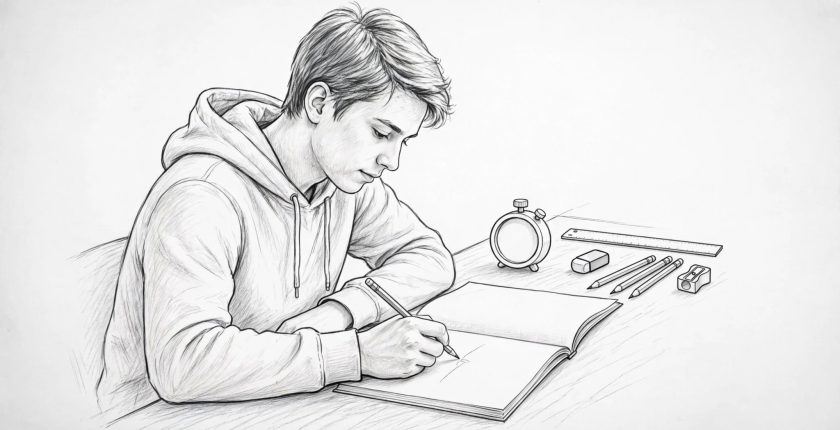
A fast hand can still produce a weak exam script if writing becomes cramped, unclear, or careless. The useful target is sustainable handwriting speed: enough to finish while preserving answer accuracy, relevance, and legibility.
Improving handwriting speed starts with small mechanical changes, then builds through timed practice across different writing tasks. Slow recall, planning, or decision-making involve cognitive function, not necessarily slow hand movement. Appropriate pace expectations also vary across age groups.
Key Takeaways
- Aim for legibility, accuracy, and answer quality first. A few clear words that meet the mark scheme beat a rushed paragraph the examiner cannot read.
- Set a personal handwriting speed baseline, but treat comparisons across age groups as context, not an exam target.
- Test your handwriting speed under exam-like conditions, because copying a passage is faster than planning an original answer.
- Adjust your grip, posture, paper angle, and letter size before trying to push your pace.
- Practise in short timed blocks, then review both your word count and the quality of the answer. If pain, tremor, fatigue, dysgraphia, or another condition affects writing, ask your school or exam provider about appropriate support early.
Set a useful handwriting speed baseline
Many students judge their handwriting speed by how quickly they can copy notes. Exams demand more. You must read, recall, select relevant information, plan, and write under a fixed time limit. Your hand movement is only one part of the writing speed shown in an original answer.
For everyday adult handwriting, broad handwriting speed norms often sit around 13 to 18 words per minute when composing original material. Casual copying can reach 20 to 25 words per minute. Children may begin around 4 to 10 in early elementary years, while teenagers may work within a broad 10 to 25 range.
These figures are broad estimates, not exam prescriptions. Fine motor skills and visual-motor integration develop differently across age groups. Previous handwriting instruction, practice history, and digital technology can also affect comparisons.
Copying and composing test different skills
Copying keeps the next word in view. Open-ended composition requires retrieval and decision-making, so it usually feels slower. Cognitive function, including planning and judgment, affects the result. A history response, law problem, or science explanation can stall because you are thinking, not because your hand is failing.
Typing with digital technology also doesn’t provide a direct benchmark for handwritten exam work. Slow composing may reflect reading, recall, or processing speed rather than weak pen mechanics. This is why copying and original writing assignments should be measured separately.
Measure both tasks. First, copy a simple paragraph for two minutes. On another day, answer a past-paper question for the same period. Record readable output in words per minute, then count only relevant words. The gap shows whether you need writing drills, content practice, or both.
Use your own exam benchmark
Your handwriting speed target depends on the paper. A calculation exam needs clear workings, symbols, diagrams, and units. An essay paper needs enough time to plan, develop points, and check that each paragraph answers the command word.
Age-based norms should be interpreted differently across age groups. Your own handwriting speed benchmark is more useful than a general comparison.
Divide the exam minutes by the available marks, then reserve five to ten minutes for review. This produces a practical pace target for each question. Record how long larger questions take during practice instead of relying on vague impressions.
A fast answer that misses the command word wastes more time than a slower answer that earns the available marks.
Fix the mechanics that slow your handwriting speed
Before practising harder, remove sources of tension that can reduce handwriting speed. Small adjustments help your fine motor skills work efficiently and prevent unnecessary effort. Pressing too hard, bending your wrist, or gripping a pen as if it might escape makes your fingers tire early.
Research on pen-grip movement in children with handwriting difficulties shows why grip and movement patterns deserve attention. Don’t chase a perfect-looking hold from handwriting instruction. Choose a position that keeps your fingers mobile and avoids pain.
Relax your grip and reduce excess motion
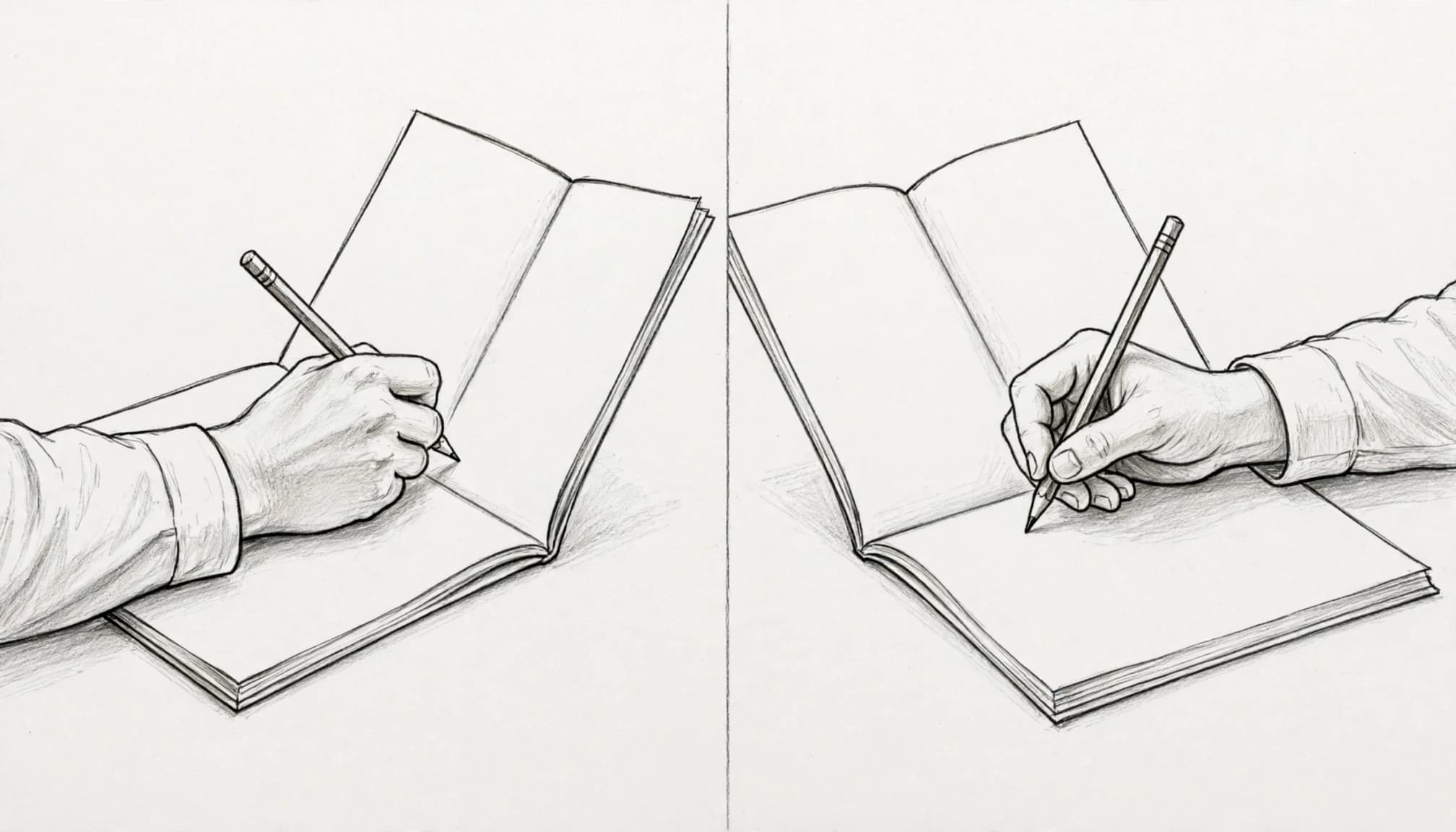
Hold the pen firmly enough to control it, but lightly enough that your thumb and index finger don’t ache. Use only enough pressure for control, rather than relying on hand strength. Let the pen rest against the side of the middle finger. Keep your forearm on the desk and move it gradually across the page instead of drawing every letter with finger-only movements.
These grip and pressure changes can protect handwriting speed. Choose writing tools that glide without skipping. A ballpoint that needs heavy pressure can slow you down. Test a gel pen, rollerball, or approved fineliner during ordinary classwork before bringing it to an exam.
Write slightly smaller only if your letters remain distinct. Large loops, oversized capitals, and dramatic slant consume time. However, cramped letter formation with closed loops creates a marking problem.
Position paper for your writing hand
Good paper positioning helps your writing hand stay comfortable and supports handwriting speed. Right-handed writers usually benefit from angling the top of the page slightly left. Left-handed writers often find a slight rightward angle more comfortable, because it helps the wrist stay below the line instead of curling above it.
Your non-writing hand should hold the page still. Sit with both feet supported, shoulders relaxed, and the paper close enough that you don’t hunch forward. Keep your forearm supported to preserve hand strength during sustained writing, but remember that greater strength alone won’t fix a tense technique. For more left-handed setup ideas, see this guide to left-handed handwriting.
Build handwriting speed with measurable drills
Practice works when it is short, repeatable, and reviewed. Controlled drills build handwriting speed without teaching tension or an unsustainable pace.
Follow a four-week practice plan
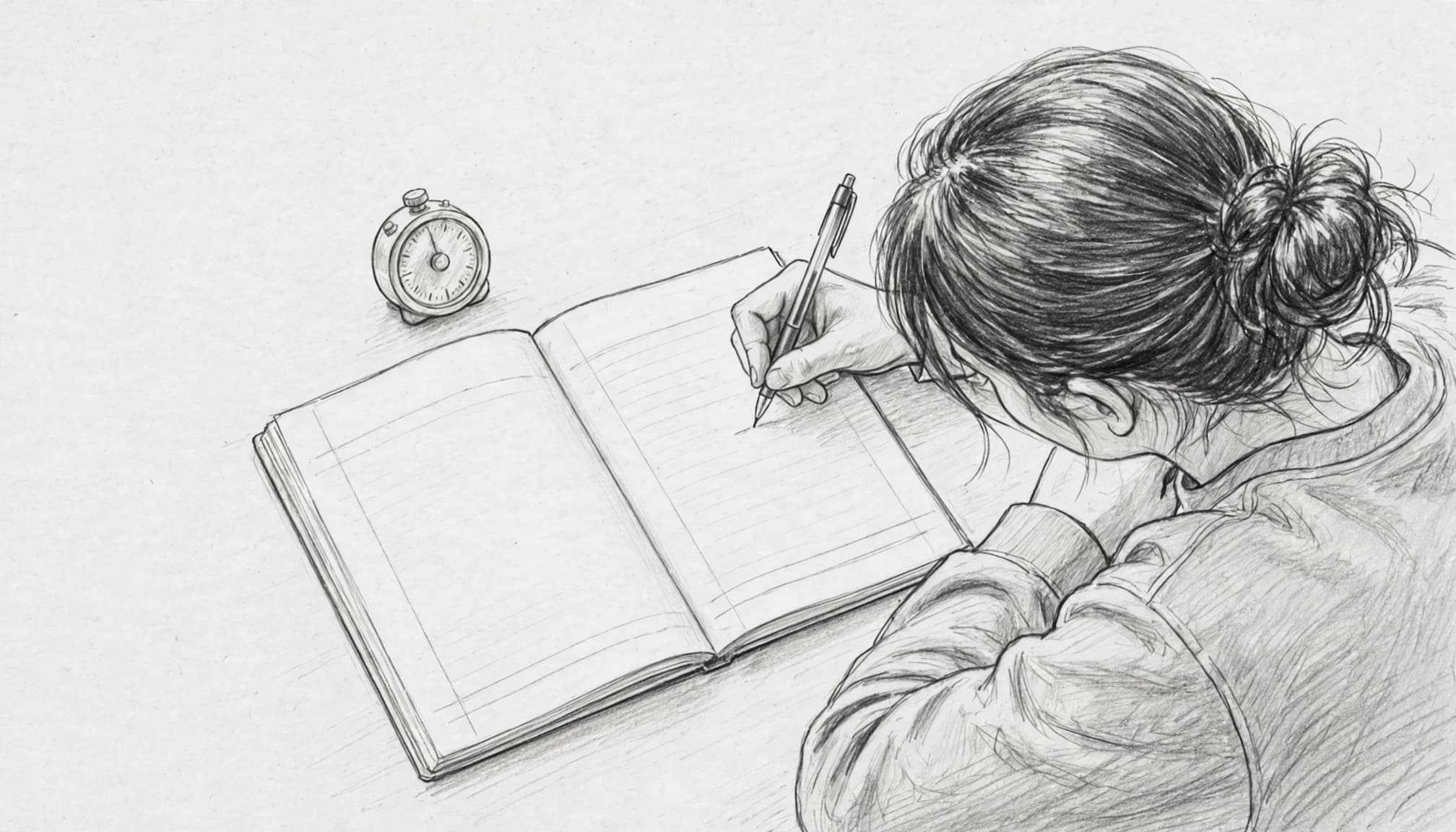
Use this plan three or four days each week. Keep one notebook or document for timing results, readability notes, and recurring problems.
- Week 1: Complete two 2-minute copying drills and one 3-minute original response. Count readable words and circle letters that become unclear. An original timed response also tests cognitive function, including thinking and decision-making.
- Week 2: Move to 5-minute timed answers from your subject. Focus on relaxed pressure, even spacing, and complete words.
- Week 3: Write one question under its real mark-based time allowance. Add a one-minute plan before you write if the question needs it. Use this stage to test a controlled handwriting speed.
- Week 4: Complete a longer section of a past paper under realistic conditions. Review timing by question, not only the total score, to build writing stamina.
Take a short break between drills. Shake out your hand, roll your shoulders, and stretch your fingers gently. Relaxation supports hand strength and endurance without encouraging a forceful grip. If hand fatigue or discomfort remains after resting, stop rather than training through pain.
Track clarity as well as words
At the end of each drill, score yourself out of five for legibility. Can someone else read it without asking? Check spacing, visual-motor integration, capitals, punctuation, numbers, and technical terms.
Use this simple record after every session:
| Drill | Time | Readable output | What to fix next |
|---|---|---|---|
| Copying passage | 2 minutes | Words per minute from readable words only, plus clarity score | Grip pressure or letter size |
| Short-answer response | 5 minutes | Marks earned and readable words | Recall or answer length |
| Extended response | Mark-based limit | Paragraphs completed and clarity | Planning or time control |
A higher writing speed isn’t an improvement if readability, accuracy, or marks fall. Treat stable clarity as the gate while increasing output. If any measure drops, return to the last controllable handwriting speed.
Write efficiently without weakening answer quality
Handwriting speed can improve while your answers lose marks because the problem isn’t always the pen. Many students spend too long deciding what to say, then rush the final half of the paper.
The goal is controlled handwriting speed, not rushed production. Good handwriting speed gives you time to finish while keeping answers readable and complete.
Plan extended answers in brief notes
For a six-mark explanation or essay paragraph, spend a small portion of the available time listing the points you must include. Selecting relevant points and interpreting command words uses cognitive function, even when your hand is still. A compact plan prevents repetition and gives your hand a clear route through the response.
Use the question’s command word as a limit. “State” often needs a concise fact. “Explain” needs a reason or mechanism. “Evaluate” needs a supported judgement, not a long list of unconnected information.
Use familiar letter forms
Cursive handwriting can be quick when it is automatic and consistently readable. Familiar letter forms and consistent joins improve writing fluidity by reducing hesitation between letters and words.
Compare cursive handwriting with neat print or a hybrid style. It only helps when your writing remains easy to read. If your joins cause letters to merge, neat print may be faster because you spend less time correcting yourself.
Avoid changing your script type days before a test. Instead, make one adjustment at a time, such as simplifying a slow capital letter or reducing an unnecessary flourish. Technical vocabulary, equations, names, and figures should remain especially clear.
Practise with real exam timing
A handwriting drill improves physical endurance. A past paper tests whether your handwriting speed holds when cognitive function involves reading, recall, judgement, and application.
Use a paper that matches your current course, question formats, and writing tasks. Clear your desk, silence notifications, keep notes out of reach, and use the official time limit to test whether your handwriting speed is sustainable. Read every instruction before starting.
Spend time in proportion to marks
Write the start and finish time beside larger questions. After marking, compare minutes used with marks available. A raw words per minute figure matters less than marks earned and questions completed. A faster result isn’t success if answer quality or command-word accuracy declines.
If your writing speed seems slow, check whether uncertainty, planning, or over-answering caused the delay. You may have been unsure of the content, trying to write too much, or misreading the task.
When you get stuck, write any relevant method, fact, diagram, or first step that could earn credit. Leave space and return later. Do not let one difficult question consume the paper.
Review the cause of slow work
Review whether your handwriting speed worked under pressure, then label lost marks. A useful label might be a knowledge gap, an application gap, a question-reading error, a comprehension or processing speed delay, a presentation issue, or a careless slip.
For written subjects, compare your response with the mark scheme or model answer. Then produce a fresh paragraph on a related question a day or two later, treating it as a new writing assignment. Rewriting the same model answer does not prove you can produce it under pressure.
Use exam-day habits that protect your pace
Choose approved pens and bring spares if your exam rules allow them. Test the same pen and grip during practice, so your handwriting speed feels familiar. A new pen on exam morning is an unnecessary variable.
At the desk, use good paper positioning, settle your posture, and write the question number clearly. Start with a short scan of the paper and budget time by marks. Keep your handwriting speed steady for the opening questions rather than sprinting and tiring your hand.
If your hand begins to tighten, pause for a few seconds between questions. Loosen your grip, lower your shoulders, and reset the page. Don’t grip harder to compensate for fatigue, since the goal is comfortable control, not extra hand strength. These brief resets can protect handwriting speed and prevent several messy lines later.
Put your pen down when the timer ends. Extra practice minutes produce misleading timing data and make the next session less useful.
When slow writing needs extra support
Writing pace develops differently across age groups, and handwriting speed norms vary widely, so they shouldn’t diagnose an individual. Development involves fine motor skills, hand dexterity, visual-motor integration, visual perception, spelling, and attention. Slow handwriting alone doesn’t indicate weak cognitive function.
Older students can also struggle when a disability, injury, arthritis, hand tremor, weak hand strength, or fatigue limits control and endurance. Complex scripts may take longer because each character requires more strokes. Persistent difficulty with handwriting speed needs attention. Stop and seek appropriate professional support for pain, numbness, weakness, cramping, tremor, or sudden changes.
Students with dysgraphia, motor conditions, or documented writing limitations should speak with a teacher, disability office, occupational therapist, or exams officer well before test day. Appropriate handwriting instruction can help, and support needs differ across age groups.
Support may include extra time, rest breaks, a word processor as a digital technology alternative, a scribe, or other approved arrangements, depending on the exam provider’s rules. For younger writers, occupational therapy can address posture, hand-eye coordination, grip, and letter formation, as outlined in school-age handwriting support guidance.
Frequently Asked Questions
What handwriting speed should I aim for in an exam?
Aim for a personal handwriting speed that lets you complete your paper with clear answers and time to check them. Words per minute can offer a rough essay metric, but marks, diagrams, calculations, and planning matter more than raw word count.
Your writing speed is only part of the result. Thinking, planning, and producing a relevant answer also take time. Measure your handwriting speed by tracking typical questions, then compare that timing with their marks. Your own past-paper results are more useful than a generic adult average.
Will writing in cursive make me faster?
Cursive handwriting can help if the joins are automatic and easy to read. It slows you down when letters collide, words become hard to separate, or you pause to remember joins.
Use the style that lets you form common words with the least effort. Clear print, consistent joins, or a hybrid style are all acceptable if your answers remain easy to read.
What if my hand hurts during timed practice?
Stop the drill and rest. Check whether you are gripping too tightly, pressing hard, or writing with a bent wrist. Pain can limit your handwriting speed, so reduce the session length until you can write comfortably.
Pain, tingling, weakness, tremor, or repeated cramping deserves professional advice. Don’t treat physical distress as a lack of discipline.
Conclusion
Better handwriting speed comes from controlled mechanics, realistic timing, and answers that stay easy to read. These combined habits make handwriting speed more reliable under exam pressure. Practice your actual exam tasks, review where minutes disappear, and improve one problem at a time.
The strongest script is not the one written fastest. It’s the one that gives the examiner clear, accurate evidence of what you know.