
Blog
Pythagorean Theorem
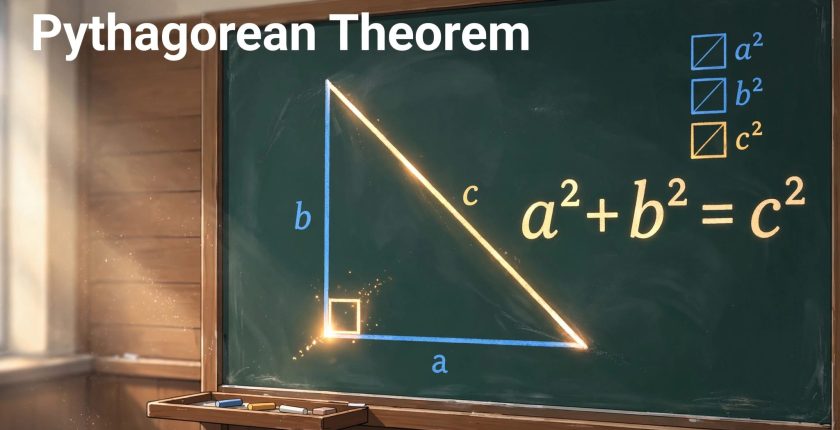
To solve Pythagorean theorem questions, identify the hypotenuse, substitute the known lengths into the theorem, then solve. The Pythagoras theorem, also called the Pythagorean theorem, relates the side lengths of a right triangle. Correct labeling matters most: adding when you should subtract usually starts with choosing the wrong side.
You can make your answers easier to check by giving each calculation its own line. Start by finding the right angle, even when the triangle looks tilted.
Key takeaways
- Use the theorem only when the triangle has a right angle.
- Add the squares of the sides to find the longest side; subtract to find a missing side.
- Finish with a square root, include units, and check your answer in the original equation.
Understand the formula before calculating
Identify the hypotenuse
The Pythagorean theorem states:
a² + b² = c²
Here, a and b are the sides of a right triangle, and they meet at the right angle. The longest side, c, is opposite that angle, so c is always the hypotenuse.
You can swap a and b, but c is always the longest side in this formula. A diagram’s orientation doesn’t change the rule.
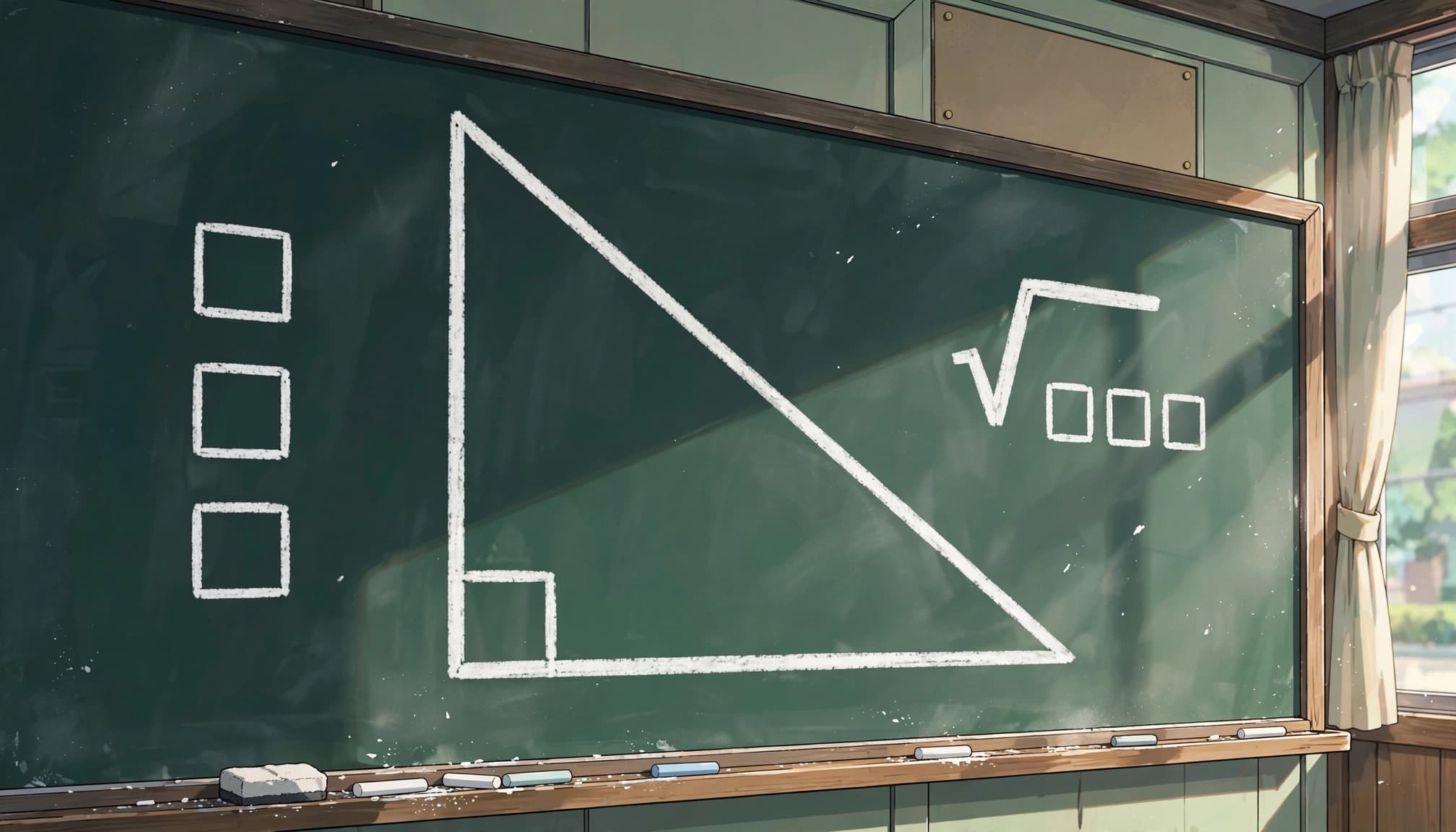
Understand what the squares mean
Imagine drawing a square on each triangle side. Their areas are a², b², and c². For a right triangle, the two smaller squares have the same combined area as the largest.
One proof arranges four identical right triangles inside a larger square. Rearranging them leaves either two smaller squares or one larger square in the remaining space. Because that remaining area stays unchanged, the theorem holds.
The 8th grade Common Core geometry standards cover explaining the theorem, applying it in two and three dimensions, and calculating coordinate-grid distances.
Follow the same method every time
Read the question before calculating. It might ask for an exact answer, a decimal, or an explanation.
- Find the right angle and label the opposite side c.
- Label the sides a and b, then write a² + b² = c².
- Substitute the known lengths, using matching units.
- For a missing side, rearrange the equation before substituting. Calculate the squares and simplify.
- Take the positive square root, state the units, and check your answer.
Convert units before substitution. For example, change 50 cm to 0.5 m if the other length is in metres.
Write each substitution and calculation on its own line. The guidance on showing working in mathematics exams explains how clear substitutions and rearrangements make your method easier to follow.
If a square root gives a negative number inside it, recheck your labels and subtraction. Valid side-length data won’t produce that result.
Worked Pythagorean theorem questions: missing sides
Find the hypotenuse: sides of 3 cm and 4 cm
Because both known sides meet at the right angle, add their squares:
3² + 4² = c² 9 + 16 = c² 25 = c² c = √25 c = 5 cm
5 is longer than either sides, and 3² + 4² = 5².
The lengths 3, 4, and 5 form a 3-4-5 triangle and a Pythagorean triple: three positive whole numbers that satisfy the theorem.
Give exact answers or round as requested
Simplify a square root
Suppose the hypotenuse is 11 cm and one side is 3 cm:
x² = 11² − 3² x² = 121 − 9 x² = 112 x = √112 x = √(16 × 7) x = 4√7 cm
This is an exact surd answer. Since 4√7 = 10.583005…, it becomes 10.6 cm to three significant figures or 10.58 cm to two decimal places.
Keep the square root on your calculator until the final step. Early rounding can change the final answer.
Solve a right isosceles triangle
A right isosceles triangle has equal sides. If the longest side is 2√3, call each side x:
x² + x² = (2√3)² 2x² = 4 × 3 2x² = 12 x² = 6 x = √6
(√6)² + (√6)² = 6 + 6 = 12.
Use the positive root because a side length can’t be negative.
Turn real-world problems into right triangles
Sketch the situation first. Identify two perpendicular lengths and the longest side, c.
Ladder against a wall
A 15 ft ladder reaches 12 ft up a vertical wall. Assuming level ground, find the horizontal distance x:
x² + 12² = 15² x² = 225 − 144 x² = 81 x = √81 = 9 ft
9² + 12² = 81 + 144 = 225 = 15².
Monitor diagonal
A rectangular monitor measures 27 in by 36 in. Its corner-to-corner length d is the hypotenuse:
d² = 27² + 36² d² = 729 + 1296 d² = 2025 d = √2025 = 45 in
45 exceeds both screen dimensions, as a diagonal should.
Lamp post and shadow
A vertical 20 m lamp post casts a 99 m shadow on level ground. Find the direct distance d between its top and the shadow’s tip:
d² = 20² + 99² d² = 400 + 9801 d² = 10201 d = √10201 = 101 m
The distance is exactly 101 m under these assumptions. Similar right-triangle calculations appear in architecture, construction, navigation, and surveying.
Test whether three lengths form a right triangle
Use the converse test to check whether a triangle is a right-angled triangle: compare the square of its longest length with the sum of the squares of the other two lengths.
For 3, 4, and 5:
3² + 4² = 9 + 16 = 25 5² = 25
The values match, so the triangle is right-angled.
For 5, 6, and 7:
5² + 6² = 25 + 36 = 61 7² = 49
Because 61 ≠ 49, this triangle isn’t right-angled.
Don’t apply the theorem to an unmarked triangle simply because it looks approximately square at one corner.
Extend the method to coordinates and 3D boxes
Distance between two coordinates
Find the distance between two points, (1, 2) and (7, 10). The horizontal and vertical differences form perpendicular sides:
Horizontal difference = 7 – 1 = 6 Vertical difference = 10 – 2 = 8 d² = 6² + 8² d² = 36 + 64 = 100 d = √100 = 10 units
Sketching the horizontal and vertical movements helps you avoid mixing an x-coordinate with a y-coordinate.
Internal diagonal of a box
For a rectangular box, also called a rectangular prism, the internal diagonal is:
D = √(l² + w² + h²)

For dimensions 3 cm, 4 cm, and 12 cm, first find the longest inside length across the base:
d² = 3² + 4² = 9 + 16 = 25 d = √25 = 5 cm
Then combine this 5 cm result with the perpendicular height:
D² = 5² + 12² D² = 25 + 144 = 169 D = √169 = 13 cm
The combined formula works because these two applications use perpendicular lengths. It doesn’t apply to every three-dimensional shape.
For individual support with geometry, Find your tutor here.
If you choose to purchase a product or service through one of these links, we may receive a commission at no additional cost to you. Any recommendations are provided for informational purposes only.