
Blog
How to Answer Science Diagram Questions in Exams
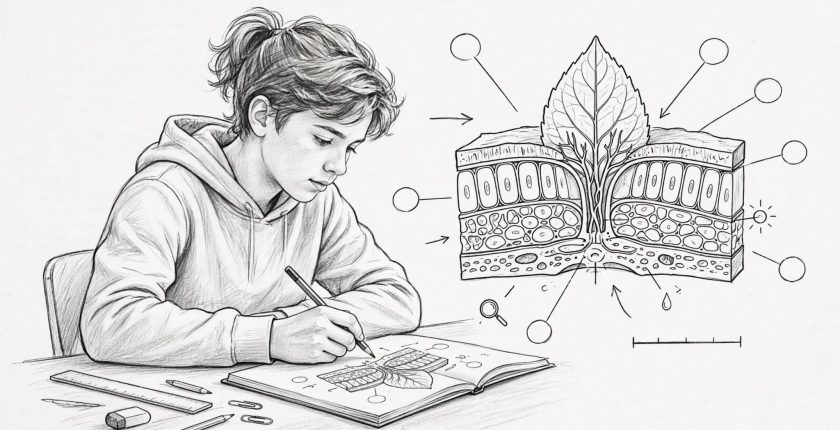
A diagram can look unfamiliar and still contain enough clues to earn marks. The strongest answers come from reading lines, arrows, labels, and scale information carefully before you start writing.
In these questions, you may need to identify a structure, describe a pattern, explain a process, or draw a clear scientific sketch. Once you separate those tasks, diagrams become evidence rather than a memory test.
Start by working out what the question wants you to do with the picture.
Key Takeaways
- Read the command word, title, labels, arrows, symbols, units, and key before answering.
- Distinguish between describing visible evidence and explaining the scientific reason behind it.
- Use accurate labels, standard symbols, clear lines, and correct arrow directions when drawing or annotating diagrams.
- Practise the diagram tasks required by your course using closed-book, timed questions and official mark schemes.
- Check that every label points to the intended feature and that your answer matches the number of marks and wording of the question.
What science diagram questions are really testing
A diagram question rarely tests drawing skill alone. It tests whether you can use scientific knowledge accurately and communicate it in the format the examiner requested.
Read the command word before studying the image
Command words tell you how much detail to include. “Label” needs the correct name placed clearly. “State” asks for a short fact. “Describe” asks what the diagram shows. “Explain” needs a scientific reason or cause.
For example, a question may show a leaf cross-section and ask you to describe the distribution of stomata. You could write that there are more stomata on the lower surface. If it asks you to explain this distribution, add that the lower surface is less exposed to sunlight and air movement, so less water evaporates.
A correct scientific fact may earn no credit if it does not answer the command word.
Treat every line, arrow, and symbol as evidence
First, scan the title, axes, key, units, direction arrows, and labels. Then look for changes, comparisons, and connections. A larger arrow may show a greater force, but only if the key or context supports that meaning.
Do not assume a diagram is perfectly drawn or to scale. A cell drawing may enlarge a nucleus so you can see it. A circuit may use neat straight wires even though real wires bend. Use the symbols and labels, not the apparent size of objects, to guide your answer.
Decide whether you must draw or label
Students often spend hours redrawing every diagram in a textbook. A more focused approach is to identify which diagrams your course expects you to reproduce from memory.
Biology often focuses on interpretation and labels
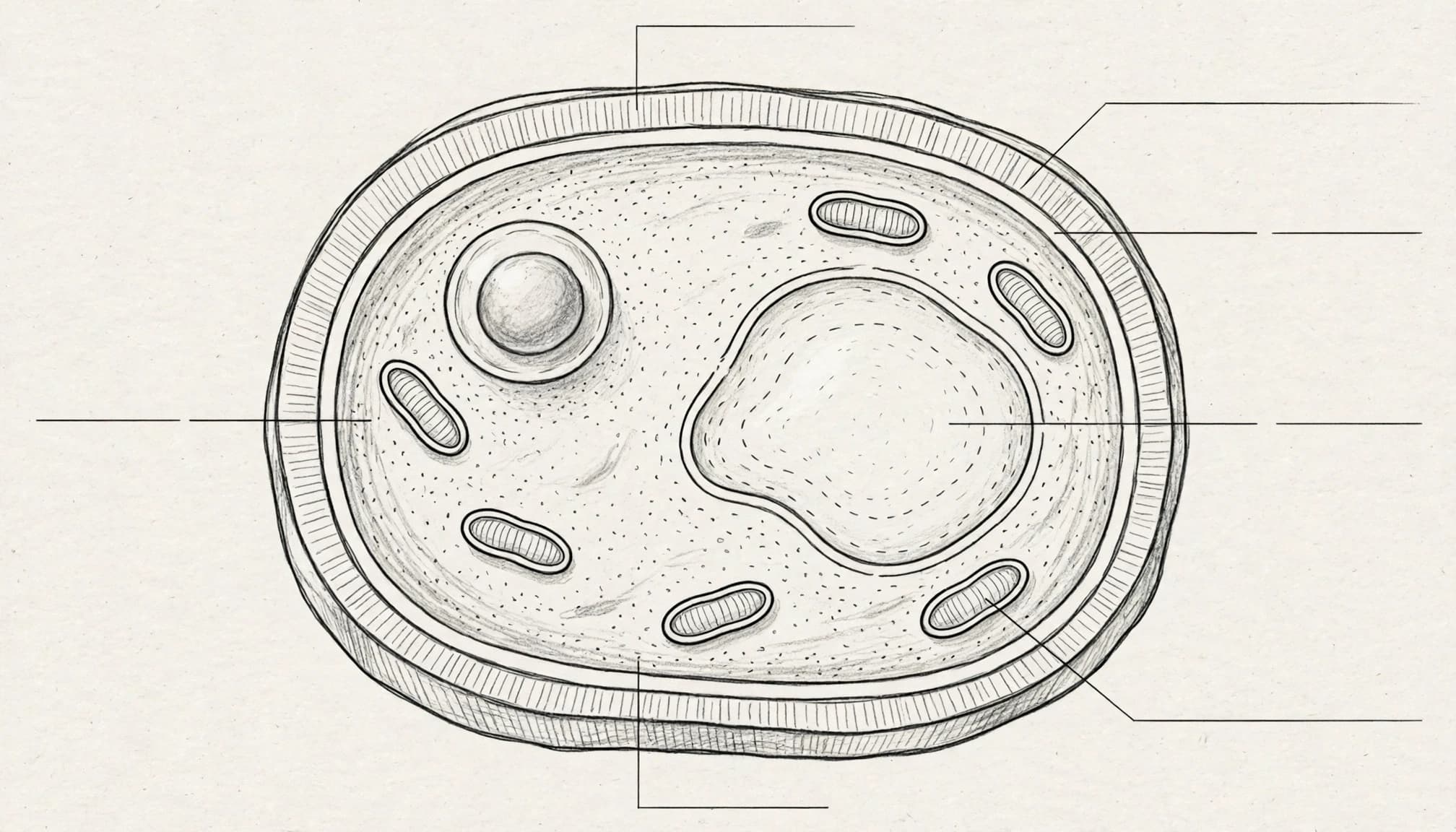
In many GCSE biology exam questions, you’re more likely to receive an outline diagram to label, annotate, compare, or use as evidence. You may need to name structures in a plant cell, identify part of the heart, or explain an adaptation shown in a drawing.
Still, practise simple biological drawings from memory. A labelled digestive system, flower, neuron, or stages of cell division can reveal gaps that reading revision notes may hide. Use your specification and past papers to identify diagrams that recur.
Physics and chemistry may require construction
Physics questions can ask you to draw circuit diagrams, free-body diagrams, or graph lines. Chemistry may require displayed formulae, a carbon skeleton, particle diagrams, apparatus set-ups, or electrolysis diagrams.
The exact requirements vary by exam board and tier. Check the course specification, teacher guidance, and official mark schemes rather than relying on a general revision list.
| Subject area | Common diagram task | What earns marks |
|---|---|---|
| Biology | Label an organ, cell, or system | Accurate names and functions |
| Chemistry | Draw a structure or apparatus | Correct symbols, bonds, and connections |
| Physics | Show forces, or circuits | Correct direction, standard symbols, clear arrows |
Read a diagram before writing your answer
Rushing into an answer causes avoidable errors. Give yourself a short routine for extracting the useful information.
Identify the object and the viewpoint
Ask what the diagram represents, then establish the viewpoint. Is it a cross-section, side view, magnified image, circuit schematic, or sequence over time?
Real photographs show natural variation, texture, and context. However, they can include distracting detail. Scientific diagrams remove unnecessary features and highlight relationships that matter for the question. Both are useful in a science investigation, but they do different jobs.
Describe what you see, then explain why it happens
Description and explanation use different kinds of sentences. Mixing them can leave an otherwise knowledgeable answer incomplete.
Description reports a visible pattern
A description stays close to the evidence in the diagram. It may compare, locate, count, or state a direction.
For a graph of temperature during a change of state, a description could say: “The temperature rises at first, then stays constant for three minutes, before rising again.” That statement tells the examiner what the graph shows.
Avoid adding reasons when the question asks only for a description. Extra writing can waste time and make a short answer less precise.
Explanation links evidence to scientific knowledge
An explanation gives the mechanism behind the observed pattern.
A useful structure is:
- State the feature shown in the diagram.
- Name the relevant scientific idea.
- Link the idea to the feature using “because,” “so,” or “therefore.”
Draw scientific diagrams that earn credit
A good diagram is simple enough to read in seconds. It does not need artistic shading, realistic colour, or a perfect outline.
Use clear lines, labels, and accepted symbols
Draw with a sharp pencil unless your exam instructions say otherwise. Use single, unbroken lines for outlines and a ruler for label lines. Keep labels horizontal where possible, and do not let label lines cross.
In physics and chemistry, standard conventions matter. Circuit symbols must be recognisable. Force arrows need clear arrowheads. For a carbon structure, every bond and atom position must make chemical sense.
Show forces with arrows in the right direction
A force diagram isolates one object and shows every force acting on it. Draw arrows from or near that object, then label each force. The arrow direction matters more than artistic realism.
Practise diagrams with retrieval, not tracing
Tracing can help you learn a shape once, but it does not prove that you can recall labels or apply the diagram under exam conditions. Closed-book practice gives a clearer result.
Use topical questions before full papers
Choose one topic, such as circuits, the eye, particle models, or forces. Complete four to eight questions from the correct course and exam board without notes. Include different task types: labelling, drawing, interpreting, and explaining.
After marking, sort mistakes into knowledge gaps, reading errors, presentation errors, and careless slips. “Wrong label” needs a different fix from “explained diffusion when the question asked for osmosis.”
Mark against the wording, not your intention
Use the official mark scheme after you finish the question. Award marks for what is visible on the page, not for an answer you meant to write. Mark schemes often accept more than one phrasing, so look for the required idea rather than copying a model response word for word.
Keep a brief error log. Record the diagram topic, what you missed, why it happened, and the action you will take. Then retest yourself later with a changed question.
A concise checklist can help before you move on:
- Read the command word and every label before answering.
- Check whether the question needs a name, a description, or an explanation.
- Use arrows, line styles, units, and symbols exactly as the diagram shows.
- Add scientific reasons only when the question asks for them.
- Check label lines, arrow directions, and spellings of key terms.
- Leave time to revisit diagrams that felt uncertain.
Handle diagram questions calmly on exam day
Exam pressure can make a familiar diagram look harder than it is. A short, repeatable routine keeps your attention on the marks available.
Spend marks and minutes in proportion
Look at the mark total before writing. A one-mark label should not take a full paragraph. A six-mark explanation may need several linked points, each tied to the image or data provided.
Check for these errors before handing in.
Frequently asked questions about science diagrams
Do biology exams require diagrams from scratch?
Some do, but many biology exam questions provide a diagram for you to label, interpret, or annotate. Practise core drawings from your own course, yet give equal attention to identifying structures and explaining functions.
Where can I find diagram practice questions?
Start with official past papers, mark schemes, and topic question packs from your exam board or teacher. Use the same specification as your final exam. Interactive questions can be useful, but practise some answers on paper without a word bank.
Build confidence one diagram at a time
Strong diagram answers come from careful reading, precise scientific vocabulary, and clear links between evidence and explanation. You do not need beautiful drawings, but you do need accurate conventions and labels.
Practise science diagram questions under timed, closed-book conditions, then use the mark scheme to find the exact gap. Each corrected diagram gives you a clearer route to the next mark.