
Blog
Biology Revision: Connect Causes and Effects
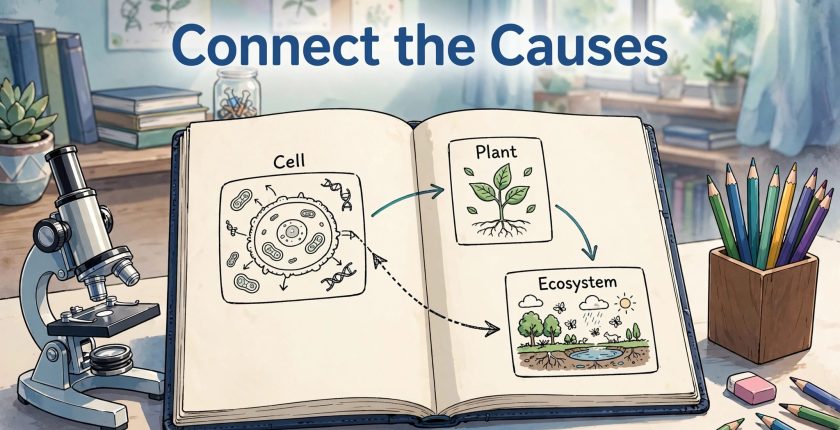
Effective biology revision means explaining how one change causes the next, then testing those links without your notes. Facts become easier to use when you can connect them with because, rather than remember them as isolated statements.
You still need accurate vocabulary, but memorisation alone won’t explain an unfamiliar graph or a changing ecosystem. Start by finding gaps, then turn each biological process into a chain you can explain, question and correct.
Key Takeaways
- Build cause-and-effect chains that name the mechanism between each change and its result.
- Recall explanations and diagrams before opening your notes, then correct every inaccurate link.
- Use specification-matched questions, mark them carefully and retest the reasoning behind lost marks.
Start Biology Revision With the Specification
Effective revision should combine understanding of the specification, retrieval practice and targeted exam-question practice. Put those activities around your actual course content, rather than revising whichever chapter feels easiest.
Diagnose gaps before making more notes
Use the AQA GCSE Biology specification to turn syllabus statements into questions. For each statement, try defining the key terms, explaining the process and applying it to a question.
Separate topics you can explain independently from those you only recognise. For example, recognising the water-transport process doesn’t prove you can explain why a potato cylinder changes mass.
If you study biology as a single science, use your own board’s specification, whether you take Edexcel or OCR. AQA’s topic structure is useful, but paper content and practical requirements aren’t interchangeable.
Repair weak understanding before rehearsing it
Watch a focused explanation, such as a Cognito video, on one weak process. Make brief notes or question-based flashcards, then rewatch the video to inspect missing links.
Afterward, close everything and explain the process yourself. If you can repeat terminology but can’t explain why the next step happens, return to that mechanism before memorising the chain.
Turn Notes Into Cause-and-Effect Chains
The guide to useful science notes encourages recording explanations rather than copying whole lessons. For revision, give each statement a clear connection to the next.
Build a photosynthesis chain
The process allows plants to make glucose using light energy. That organic material also supports organisms that eat plants.
Turn notes about light intensity into this sequence:
- When light is limiting, increasing light intensity allows chlorophyll to absorb more light energy.
- With sufficient carbon dioxide and a suitable temperature, the rate of the process increases.
- More glucose is produced per unit time, providing material that can support growth and biomass production.
The conditions matter. Increasing light won’t keep increasing its rate once another factor limits it.
Check every connection for accuracy
Read each neighbouring pair of statements and explain the connection using “because”. Name the mechanism, rather than repeating that something increases.
Then inspect direction, conditions and timescale. Does the change happen immediately? Does it require oxygen? Could another variable prevent the effect?
For example, plants don’t turn energy into matter. Light supplies energy for the process; carbon dioxide and water supply the atoms used to make glucose.
A chain can contain correct facts but still give a wrong explanation if the connection between them is missing.
Cover the Seven AQA Biology Topic Areas
BBC Bitesize’s AQA Biology hub organises revision into seven areas, alongside key practicals, practical skills and an interactive quiz.
Use these connections to move beyond topic names.
| Topic area | Cause-and-effect connections to practise |
|---|---|
| Cell biology | Compare diffusion, osmosis and active transport. Link concentration differences to movement, then revise microscopy and mitosis. |
| Organisation | Connect enzyme activity to digestion, absorption to transport, and blood flow to oxygen delivery. |
| Infection and response | Vaccinations expose the immune system to antigens from specific pathogens and prompt a targeted response. Population protection depends partly on the proportion vaccinated. Antibiotics treat some bacterial diseases, not viral infections. |
| Bioenergetics | Photosynthesis makes glucose. Respiration releases energy for living processes. Aerobic respiration uses glucose and oxygen; anaerobic respiration uses glucose without oxygen. |
| Homeostasis and response | Trace a change through detection and a corrective response, such as blood glucose regulation. |
| Inheritance, variation and evolution | Connect inherited variation, selection pressures, reproductive success and changing allele frequencies. |
| Ecology | Trophic levels are feeding stages in food chains, and changes in food-web relationships or population sizes can affect biodiversity. Biomass is the total mass of living material at each level. Decomposition depends on decomposer numbers, temperature, water and oxygen availability. |
These links give you starting points, rather than complete coverage of each topic.
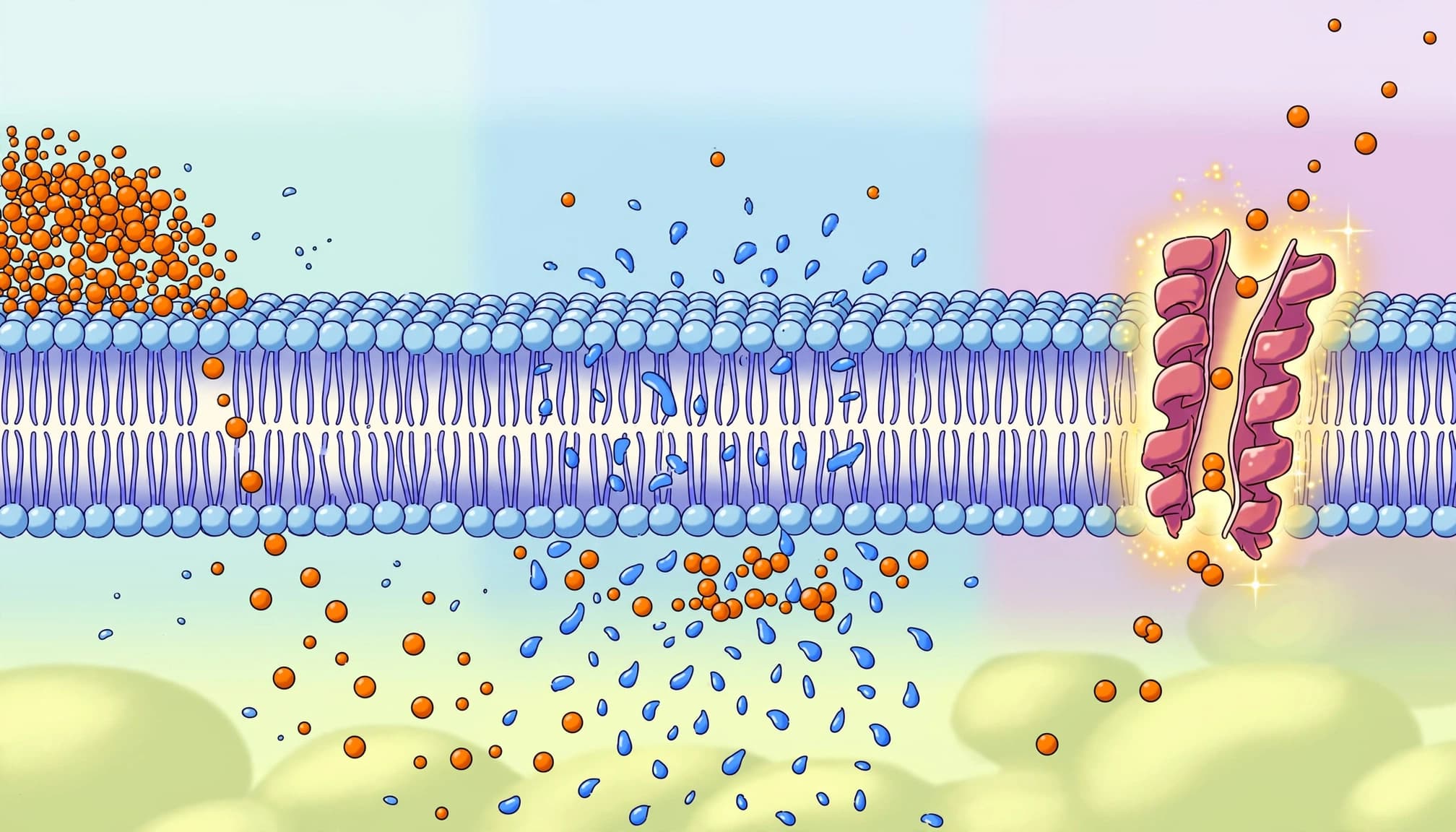
For cell transport, keep the mechanisms separate. Diffusion produces net movement down a concentration gradient. Water moves across a partially permeable membrane down a water-potential gradient. Active transport moves substances against their concentration gradient using energy released by respiration.
Test Understanding With Questions and Diagrams
Active recall means producing an answer before seeing it. The active recall techniques include drawing, explaining and answering questions, so practice resembles the thinking an exam requires.
Write everything you remember about a topic, then adding missed information from notes in another colour. Organise the page around processes and causal links rather than scattered keywords.
For osmosis, write the starting conditions, direction of water movement and resulting change in cell mass or volume. Next, compare your explanation with your textbook.
Turn each gap into a focused question. “What causes this potato cylinder to gain mass?” demands more understanding than a simple definition.
Answer fully before turning over a flashcard. Seeing the correct explanation and recognising it doesn’t show that you could produce it independently.
Draw and explain a process
Draw a reflex arc or food web from memory. Add the relevant labels, then explain what each connection means.
Next, change one condition: damage a sensory neurone, remove a producer or reduce oxygen availability. Predict the effect and explain the mechanism.
Compare your diagram and explanation with your course materials or BBC Bitesize revision guides. Correct scientific errors as well as missing labels.
Try a 20-40-40 Revision Split as a Flexible Starting Point.
The 20-40-40 rule suggests spending 20% of revision time understanding concepts, 40% actively memorising through flashcards and 40% applying knowledge to exam questions.
Treat this as a planning suggestion, rather than a proven optimum. A badly misunderstood process needs more explanation before repeated recall becomes useful.
During the understanding portion, build and inspect a causal chain. During memorisation, reproduce its mechanisms and vocabulary without prompts. During application, answer a question that changes the context or combines topics.
Also vary your practice. Sample exam questions include multiple-choice, structured, mathematical and practical formats. For multiple choice, explain why the rejected options are wrong; for calculations, show working and units.
Use Past Papers to Repair Explanations
Start with topical exam-style questions from past papers on weak areas, then move towards mixed questions and full timed papers. Keep the correct question paper and mark scheme together, but hide the marking guidance until your attempt is complete.
Make the command word shape your answer
Good exam technique starts with matching the command word to the response. “State” usually requires a brief fact. “Explain” requires linked reasons, while “compare” asks for similarities and differences. “Evaluate” requires a supported judgement.
Mark strictly, then retest with a changed question
Follow the official mark schemes. Missing required scientific terms can lose marks, although schemes may accept several equivalent explanations.
The guide to marking practice test papers recommends reviewing the reason behind every lost mark. Record whether the problem was knowledge, an omitted link, a misread command word or a calculation error.
If an answer was far off, put the question and a corrected model response on a flashcard. Explain the creditworthy features in your own words instead of copying blindly. Then, answer a fresh question testing the same mechanism.
Revise Practical Biology Through Four Stages
Scientific investigations involve planning, collecting data, analysing data and evaluation. Connect decisions in each stage to the quality of the evidence.
During planning, identify the independent variable, dependent variable and controls. Explain why each control matters. In a potato osmosis investigation, unequal starting dimensions can complicate comparisons between samples.
During data collection, record measurements consistently and repeat where appropriate. Then analyse patterns using calculations, graphs and biological explanations. Percentage change helps compare samples with different starting masses.
Finally, evaluate how limitations affect the conclusion. Explain how the method could improve, rather than adding “repeat it” without a reason.
Include the required practicals named in your course. For example, AQA’s cell biology content includes observing, drawing and labelling plant and animal cells using a light microscope. Practise explaining magnification calculations alongside recognising structures.
Find your tutor here to explore one-to-one support matched to your learning needs.
If you choose to purchase a product or service through one of these links, we may receive a commission at no additional cost to you. Any recommendations are provided for informational purposes only.