
Blog
Learn From Worked Examples Without Copying the Steps
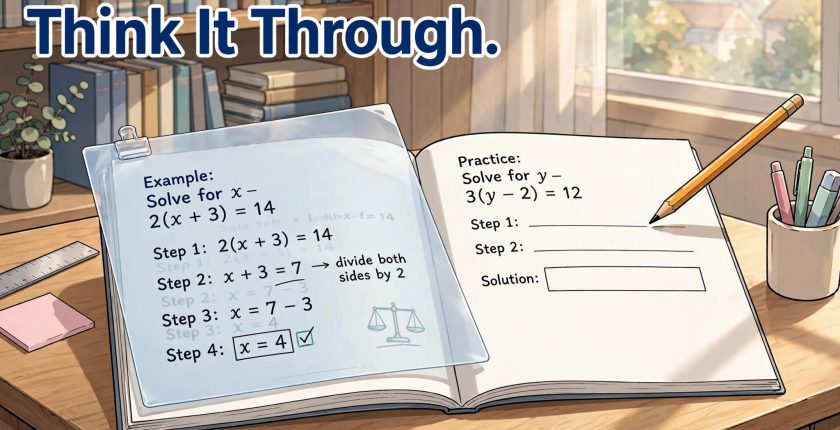
A solution can look obvious while it’s open and leave you stuck once you close the book. Worked examples help when you study the decisions behind the steps, then practise making those decisions yourself.
You don’t need to avoid worked solutions or struggle through every new topic unaided. Instead, explain each move, predict what comes next, and gradually remove the support.
Start by separating what a solution shows from what you need to learn.
Key Takeaways
- Explain why each step is valid and how it advances the solution.
- Cover the next line and predict it before looking.
- Move from complete solutions to missing-step exercises, then independent problems.
- Change the wording or structure to test whether the method transfers.
- After mistakes, correct the reasoning and retest later without the answer visible.
What Worked Examples Teach You
A worked example presents a problem, the steps used to solve it, and the final answer. A useful one also makes the reasoning visible: why a method applies, which conditions matter, and how to check the result.
A demonstration can do this too. However, watching someone solve a problem doesn’t guarantee you’re learning those decisions. You need time to examine and explain them.
Why beginners benefit from seeing a solution
When a topic is new, you’re managing unfamiliar symbols, rules, and possible approaches at once. Trial-and-error problem solving can consume your limited working memory before you notice the underlying method.
Worked examples reduce that search burden. Sweller and Cooper’s 1985 algebra study provided early evidence for learning through worked solutions.
In cognitive load theory, this benefit is called the worked example effect.
What you should remember afterward
Your goal is a reusable pattern, sometimes called a schema. That means recognizing a problem’s structure and knowing which principles apply.
For equations, remember why applying the same operation to both sides preserves equality. Memorizing that one particular solution says “subtract four, then divide by three” gives you much less help on another question.
Study Each Step Before Reading the Next

First, read the question without the solution. Identify what you’re given, what you must find, and any conditions that restrict your method. You can make this initial assessment even when you can’t yet solve the problem.
Explain the decision, not just the operation
Beside an important step, write a short explanation in your own words. “Divide by three” names an action. “Divide both sides by three to remove the factor multiplying the bracket” explains its purpose.
Ask which rule permits the move and why it’s useful here. MIT’s guidance on worked examples recommends self-explanation prompts that draw attention to the reasoning behind a solution.
If your explanation only repeats the line, look for the missing principle. Avoid copying every calculation into a second notebook. Put your effort into the decisions you couldn’t have made alone.
Pause, predict, then compare
Cover the next line with paper, or pause a video before the instructor writes it. Predict the next useful move and give a reason.
Then reveal the step. Compare the reasoning as well as the result. A different move may still be valid, so don’t treat the printed sequence as the only acceptable route.
Afterward, close the example and explain the overall method from memory. The active recall techniques use the same principle: produce an answer before checking it.
A Worked Example With the Reasoning Included
Solve 3(x – 2) + 4 = 19.
The goal is to isolate x while keeping both sides equal. Because the bracket is multiplied by three, undoing the surrounding operations is one efficient approach.
Each line below includes the reason for the move.
| Step | Working | Why it works |
|---|---|---|
| Remove the added four. | 3(x – 2) = 15 | Subtracting four from both sides preserves equality and leaves the multiplied bracket alone. |
| Remove the factor of three. | x – 2 = 5 | Dividing both sides by three isolates the expression inside the bracket. |
| Isolate x. | x = 7 | Adding two to both sides reverses the subtraction. |
| Check the answer. | 3(7 – 2) + 4 = 19 | Substitution confirms that the answer satisfies the original equation. |
The reusable idea is to reverse operations while preserving equality.
Expanding the bracket first would also work: 3x – 6 + 4 = 19, then 3x – 2 = 19. Comparing these approaches helps you distinguish a necessary rule from a preferred strategy.
A useful learning outcome is: “I can solve a linear equation with brackets and justify each transformation.” That describes something you can demonstrate, unlike “I understand equations.”
For broader practice, the mathematics revision strategies connect worked solutions with independent question solving.
Fade Worked Examples Into Independent Practice
Fading means removing parts of a solution as you become more capable. It gives you responsibility for progressively more decisions.
Alexander Renkl’s chapter on worked examples examines how example-based learning prepares students for meaningful problem solving.
Begin with completion problems
Use three versions of the equation exercise:
- Study the complete solution to 3(x – 2) + 4 = 19, explaining each transformation.
- For 4(x – 1) + 3 = 23, show only the first transformation, 4(x – 1) = 20. Complete the remaining steps yourself.
- Solve 5(x – 3) + 2 = 22 with every solution step hidden.
The answers to the second and third equations are x = 6 and x = 7. Read those only after attempting the problems.
Next, remove the first transformation too. Now you must choose how to begin, rather than merely finish an approach someone else selected.
Attempt first, then repair the gap
For independent practice, keep the example out of sight until you’ve made a genuine attempt. If you’re stuck, identify the decision you can’t make before opening it.
Reveal only enough to resolve that gap. Then close the solution and continue.
Don’t spend a whole session staring at a blank page. However, don’t reveal the complete answer at the first sign of difficulty. Use the smallest useful hint, then attempt another problem without it.
Transfer the Method to Unfamiliar Problems
Solving another equation with different numbers is a useful first test. Stronger transfer requires recognizing the same principle when the question looks different.
A review of worked-example research discusses example design and how learners build understanding from solutions. Treat each example as evidence of a general method, rather than a script tied to one page.
Change the structure as well as the numbers
After the bracket equations, try 12 = 2(x + 1) + 4. The unknown expression appears on the right, but preserving equality still governs every move.
Then try 3x + 2 = x + 10. Here, the unknown appears on both sides. You must collect variable terms before isolating x.
Ask what stayed the same and what changed. The governing principle remains valid, while the exact sequence differs.
A new problem tests transfer only if you must choose the method, rather than recognize where to insert new numbers.
Use the same approach beyond maths
For an essay model, identify how the writer connects a claim to evidence and explains its relevance. Then hide the explanation and write your own before comparing.
Next, answer a different prompt with different evidence. Keep the reasoning pattern, but avoid reproducing the model’s wording or argument.
In programming, explain why a loop stops and what each variable tracks. Then solve a related task without the sample code. Recognizing syntax alone doesn’t show that you can design a solution.
Common Pitfalls That Make Examples Less Useful
Familiarity can disguise a gap. Rereading a polished solution feels easier than generating one. Test yourself with the answer hidden before deciding you’ve mastered the topic.
Copying explanations can become another passive habit. If you write “apply the distributive law,” also explain what is being distributed and why that step helps.
Practising only identical questions limits transfer. Once the basic method is stable, mix it with questions that require a different approach. Choose the method before calculating.
Checking only the final answer hides errors. A correct result can follow faulty reasoning. Compare important transformations, units, assumptions, or evidence too.
After marking, record the error’s cause in one sentence. “I chose the wrong operation” needs different practice from “I dropped a negative sign.”
The guide to reviewing practice test papers helps turn those distinctions into targeted revision. Redo the question without copying the correction, then return later to a fresh question testing the same skill.
When to Stop Using Full Solutions
Reduce support when you can select an approach, justify the important steps, and complete a related problem without prompts. Also test the skill after a delay; immediate success may depend on remembering the example.
As prior knowledge grows, detailed guidance can become redundant or distracting. This is the expertise reversal effect: support that helps a beginner may offer less value to someone who already knows the method.
Readiness depends on the skill. You might solve basic equations independently while still needing examples for simultaneous equations. Use full solutions where the method is genuinely new, and shorter hints where only one decision causes trouble.
If you repeatedly get stuck at the same point, ask for help with that decision. A tutor can listen to your reasoning and address the gap. Find your tutor here.
Make the Reasoning Your Own
Worked examples become useful when you can explain the decisions and make them without the solution visible. Prediction, missing-step practice, and changed questions give you evidence of that progress.
For your next session, study one solution actively, close it, and attempt a related problem. Correct any gap, then retest with a different question.
The strongest sign of learning is independent reasoning when the familiar page is gone.
If you choose to purchase a product or service through one of these links, we may receive a commission at no additional cost to you. Any recommendations are provided for informational purposes only.